📖 Explanation
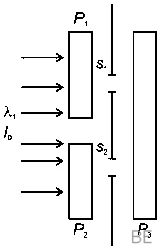
In a single slit diffraction experiment, the condition for obtaining intensity minima is given by the equation asinθ=nλ, where a is the width of the slit, λ is the wavelength of the light, and n is the integer order of the minimum. For small angles typical in these experiments, we use the approximation sinθ≈θ, which simplifies the expression for the angular position of the n-th minimum to θ=anλ. Consequently, the second minimum on the left corresponds to an angular position of a2λ, and the third minimum on the right corresponds to a3λ.
The total angular separation between these two positions is the sum of their angles relative to the central maximum, resulting in a2λ+a3λ=a5λ. Since the measured separation is 30∘, we convert this value to radians to maintain consistency in our calculation, yielding 6π radians. Equating these two expressions gives a5λ=6π, which allows us to solve for the slit width as a=π30λ. Substituting the given wavelength of 628 nm, or 0.628μm, we calculate a=3.1430×0.628μm, which simplifies to a final slit width of 6μm.