Q301JEE Main 2019MCQ
A rigid diatomic ideal gas undergoes anadiabatic process at room temperature,. Therelation between temperature and volume ofthis process is = constant, then x is :
JEE Main · Physics
Generate JEE Main level questions on Thermodynamics. Focus on Laws of thermodynamics, Carnot engine, and Calorimetry.
400 questions · 20 PYQs · 0 AI practice · JEE Main 2027
A rigid diatomic ideal gas undergoes anadiabatic process at room temperature,. Therelation between temperature and volume ofthis process is = constant, then x is :
A metal ball of mass 0.1 kg is heated upto 500°C and dropped into a vessel of heat capacity 800 and containing 0.5 kg water. The initial temperature of water and vessel is 30°C. What is the approximate percentage increment in the temperature of thewater ? $[Specific Heat Capacities of water and metal are, respectively, 4200 and 400 ]$
A Carnot engine has an efficiency of . When by , its efficiency is doubled. The temperature of the source and the sink are, respectively,
Ice at -20° C os added tp 50 g of water at 40°C. When the temperature of the mixture reaches 0°C, it is found that 20 g of ice is still unmelted. The amount of ice added to the water was close to (Specific heat of water = 4.2 J/g/°C) Specific heat of Ice = 2.1 J/g/°C Heat of fusion of water at 0°C = 334 J/g)
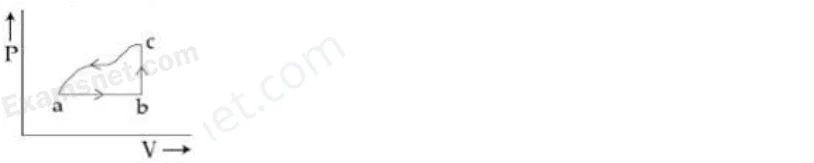
A sample of an ideal gas is taken through the cyclic process abca as shown in the figure. The change in the internal energy of the gas along the path ca is -180 J. The gas absorbs 250 J of heat along the path ab and 60 J along the path bc. The work done by the gas along the path abc is.
An HCl molecule has rotational, translational and vibrational motions. If the rms velocity of HCl molecules in its gaseous phase is , m is its mass and is Boltzman constant, then its temperature will be :
An unknown metal of mass 192 g heated to a temperature of 100°C was immersed into a brass calorimeter of mass 128 g containing 240 g of water a temperature of 8.4°C Calculate the specific heat of the unknown metal if water temperature stabilizes at 21.5°C(Specific heat of brass is 394 J )
A cylinder with fixed capacity of 67.2lit contains helium gas at STP. The amount of heat needed to raise the temperature of the gas by 20°C is : $[Given that R=8.31J ]$
A massless spring(k = 800 N/m), attached with a mass (500g) is completely immersed in 1 kg of water. The spring is stretched by 2cm and released so that it starts vibrating. What would be the order of magnitude of the change in the temperature of water when the vibrations stop completely? (Assume that the water container and spring receive negligible heat and specific heat of mass = 400 J/kg K, specific heat of water = 4148J /kg K) A.
A diatomic gas with rigid molecules does 10 J of work when expanded at constant pressure. When would be the heat energy absorbed by the gas, in this process?
When 100 g of a liquid A at 100°C is added to 50 g of a liquid B at temperature 75°C, the temperature of the mixture becomes 90°C. The temperature of the mixture, if 100 g of liquid A at 100°C is added to 50 g of liquid B at 50°C, will be :-
A gas can be taken from A to B via two differentprocesses ACB and ADB When path ACB is used 60 J of heat flows into thesystem and 30 J of work is done by the system. Ifpath ADB is used work done by the system is 10J. The heat Flow into the system in path ADB is : [9-Jan-2019 Shift 1]

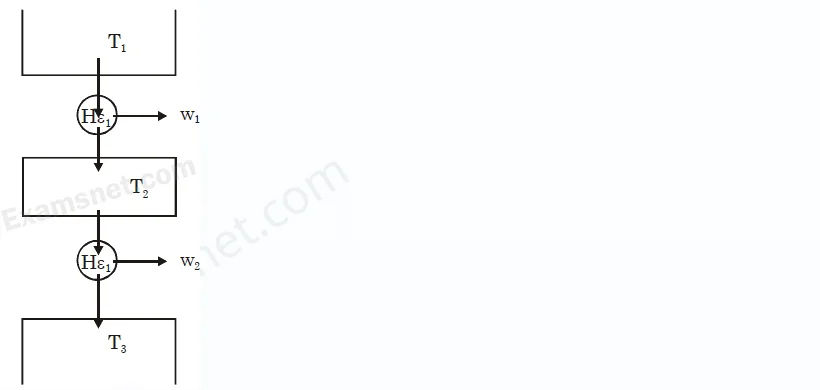
Two Carrnot engines A and B are operated in series. The first one, A, receives heat at (= 600 K) and rejects to a reservoir at temperature . The second engine B receives heat rejected by the first engine and, in turn, rejects to a heat reservoir at (= 400 K). Calculate the temperature if the work outputs of the two engines are equal :
Two rods A and B of identical dimensions areat temperature 30°C. If A is heated upto 180°Cand B upto T°C, then the new lengths are thesame. If the ratio of the coefficients of linearexpansion of A and B is 4 : 3, then the valueof T is :-
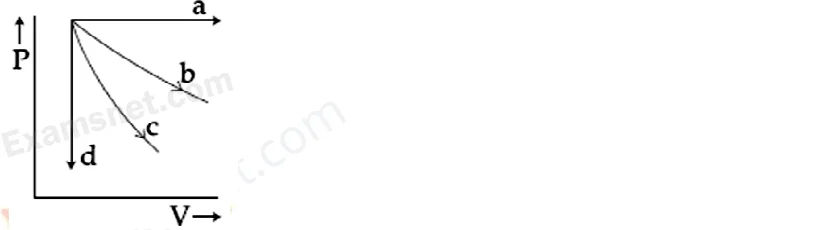
The given diagram shows four processes i.e., isochoric, isobaric, isothermal and adiabatic. The correct assignment of the processes, in the same order is given by:
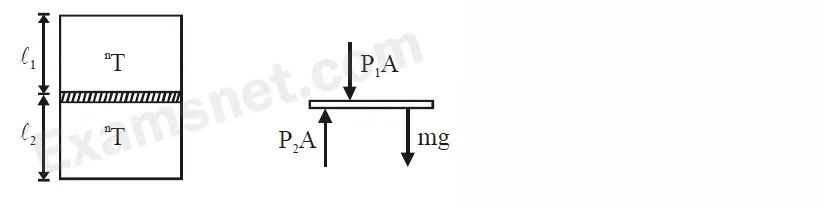
A vertical closed cylinder is separated into two parts by a frictionless piston of mass m and of negligible thickness. The piston is free to move along the length of the cylinder. The length of the cylinder above the piston is , and that below the pistonis , such that > . Each part of the cylinder contains n moles of an ideal gas at equal temperature T. If the piston is stationary, its mass, m, will be given by : (R is universal gas constant and g is the acceleration due to gravity)
Two moles of an ideal monoatomic gas occupies a volume V at 27°C . The gas expands adiabatically to a volume 2V. Calculate (a) the final temperature of the gas and (b)change in its internal energy.[Main 8 April 2018]
Two cornot engines A and B are operated in series. Engine A receives heat from a reservoir at 600 K and rejects heat to a reservoir at temperature . Engine receives heat rejected by engine and in turn rejects it to a reservoir at 100 K . If the efficiencies of the two engines and are represented by and , respectively, then what is the value of ?
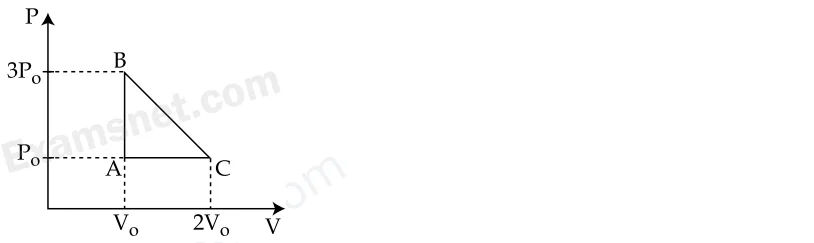
One mole of an ideal monoatomic gas is taken along the path ABCA as shown in the PV diagram. The maximum temperature attained by the gas along the path BC is given by :[Main 16 April 2018 S1]
One mole of an ideal monoatomic gas is compressed isothermally in a rigid vessel to double its pressure at room temperature,27°C. The work done on the gas will be :[Main 15 April 2018 S1]
Want unlimited AI-generated Thermodynamics questions?
Sign up free and practice with adaptive difficulty — Easy, Medium, Hard. New questions every session.
Start practising for free →