Q161JEE Main 2021MCQ
The thickness at the centre of a plano convex lens is and the diameter is . If the speed of light in the material of the lens is , then the focal length of the lens is
JEE Main · Physics
Generate JEE Main level questions on Ray Optics and Optical Instruments. Focus on Reflection, Refraction, Lenses, and Microscopes/Telescopes.
271 questions · 20 PYQs · 0 AI practice · JEE Main 2027
The thickness at the centre of a plano convex lens is and the diameter is . If the speed of light in the material of the lens is , then the focal length of the lens is
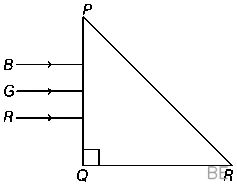
Three rays of light, namely red (R)(R)(R), green (G)(G)(G) and blue (B)(B)(B) are incident on the face PQP QPQ of a right angled prism PQRP Q RPQR as shown in figureThe refractive indices of the material of the prism for red, green and blue wavelength are 1.27,1.421.27,1.421.27,1.42 and 1.491.491.49, respectively. The colour of the ray(s) emerging out of the face PRP RPR is
A short straight object of height 100cm100 {cm}100cm lies before the central axis of a spherical mirror, whose focal length has absolute value f=40cmf=40 {cm}f=40cm. The image of object produced by the mirror is of height 25cm25 {cm}25cm and has the same orientation of the object. One may conclude from the information.
Red light differs from blue light as they have
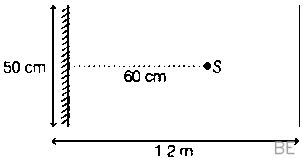
A point source of light , placed at a distance in front of the centre of a plane mirror of width , hangs vertically on a wall. A man walks in front of the mirror along a line parallel to the mirror at a distance from it (see in the figure). The distance between the extreme points, where he can see the image of the light source in the mirror is ......... .
The refractive index of a converging lens is 1.4. What will be the focal length of this lens if it is placed in a medium of same refractive index? (Assume the radii of curvature of the faces of lens are and respectively)
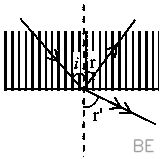
A ray of light passes from a denser medium to a rarer medium at an angle of incidence . The reflected and refracted rays make an angle of 90° with each other. The angle of reflection and refraction are respectively and . The critical angle is given by :
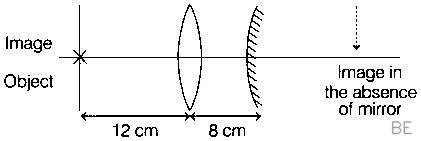
An object is placed at a distance of from a convex lens. A convex mirror of focal length is placed on other side of lens at as shown in the figure. Image of object coincides with the object. When the convex mirror is removed, a real and inverted image is formed at a position. The distance of the image from the object will be............ .
The same size images are formed by a convex lens when the object is placed at or at from the lens. The focal length of convex lens is ........... cm.
The incident ray, reflected ray and the outward drawn normal are denoted by the unit vectors , and , respectively. Then, choose the correct relation for these vectors.
A prism of refractive index and another prism of refractive index are stuck together (as shown in the figure). and depend on , the wavelength of light, according to the relation and The wavelength for which rays incident at any angle on the interface BC pass through without bending at that interface will be ________nm.
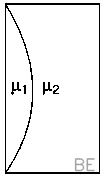
Curved surfaces of a plano-convex lens of refractive index and a plano-concave lens of refractive index have equal radius of curvature as shown in figure. Find the ratio of radius of curvature to the focal length of the combined lenses.
The angle of deviation through a prism is minimum when A. incident ray and emergent ray are symmetric to the prism B. the refracted ray inside the prism becomes parallel to its base C. angle of incidence is equal to that of the angle of emergence D. angle of emergence is double the angle of incidence Choose the correct answer from the options given below.
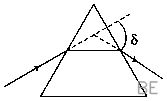
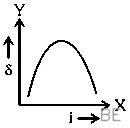
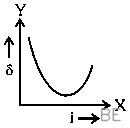
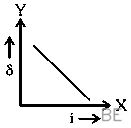
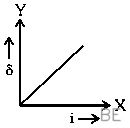
The expected graphical representation of the variation of angle of deviation 'δ' with angle of incidence 'i' in a prism is :
A glass tumbler having inner depth of 17.5 cm is kept on a table. A student starts pouring water () into it while looking at the surface of water from the above. When he feels that the tumbler is half filled, he stops pouring water. Up to what height, the tumbler is actually filled?
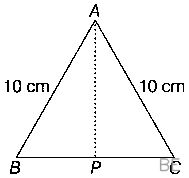
Cross-section view of a prism is the equilateral triangle ABC in the figure. The minimum deviation is observed using this prism when the angle of incidence is equal to the prism angle. The time taken by light to travel from P (mid-point of BC) to A is . (Given, speed of light in vacuum = and )
The focal length is related to the radius of curvature of the spherical convex mirror by 24 Feb 2021 Shift1
An object viewed from a near point distance of 25 cm, using a microscopic lens with magnification '6', gives an unresolved image. A resolved image is observed at infinite distance with a total magnification double the earlier using an eyepiece along with the given lens and a tube of length 0.6 m, if the focal length of the eyepiece is equal to ______ cm.
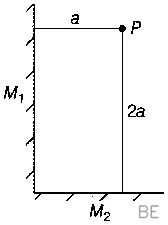
Two plane mirrors and are at right angle to each other shown. A point source P is placed at a and 2a meter away from and , respectively. The shortest distance between the images thus formed is (Take )
An object is placed at the focus of concave lens having focal length . What is the magnification and distance of the image from the optical centre of the lens?
Want unlimited AI-generated Ray Optics And Optical Instruments questions?
Sign up free and practice with adaptive difficulty — Easy, Medium, Hard. New questions every session.
Start practising for free →