📖 Explanation
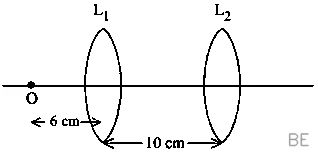
When light passes through a system of coaxial thin lenses, we analyze the refraction at each surface by treating the image formed by one lens as the object for the next, using the standard lens equation v1−u1=f1 at each step. For the first convex lens with a focal length of 24 cm, the object is placed 6 cm in front, meaning u=−6 cm. Substituting these into the formula yields v1−−61=241, which simplifies to v1=241−61=241−4=−243. This results in v=−8 cm, indicating that the first lens creates a virtual image 8 cm to the left of its optical center.
Because the lenses are separated by 10 cm, the virtual image formed by the first lens acts as an object for the second lens at a combined distance of 8 cm (from the first lens) plus 10 cm (the gap between lenses), placing it at u=−18 cm relative to the second lens. Applying the lens equation again for the second lens with a focal length of 9 cm, we have v1−−181=91. Solving for the final image position gives v1=91−181=182−1=181, so v=18 cm, confirming that the final image is formed 18 cm to the right of the second lens.
To determine the final separation between the original object and this image, we sum the distinct segments along the optical axis. The object is 6 cm to the left of the first lens, the distance between the two lenses is 10 cm, and the final image is 18 cm to the right of the second lens. Adding these components together provides a total distance of 6 cm + 10 cm + 18 cm, which equals 34 cm.