In the given figure, a body of mass is held between two massless springs, on a smooth inclined plane. The free ends of the springs are attached to firm supports. If each spring has spring constant , then the frequency of oscillation of given body is

JEE Main · Physics
Generate JEE Main level questions on Oscillations. Focus on SHM, Pendulums, and Energy in SHM.
174 questions · 20 PYQs · 0 AI practice · JEE Main 2027
In the given figure, a body of mass is held between two massless springs, on a smooth inclined plane. The free ends of the springs are attached to firm supports. If each spring has spring constant , then the frequency of oscillation of given body is

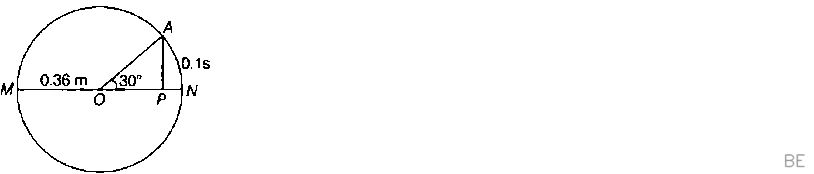
The point moves with a uniform speed along the circumference of a circle of radius and covers in . The perpendicular projection from on the diameter represents the simple harmonic motion of . The restoration force per unit mass when touches will be

A block of mass attached to a spring is made to oscillate with an initial amplitude of . After , the amplitude decreases to . Determine the value of the damping constant for this motion. (Take, In )
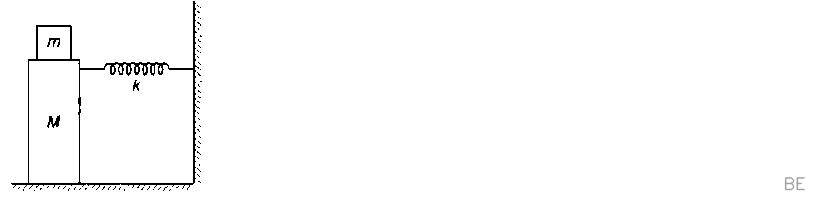
In the given figure, a mass is attached to a horizontal spring which is fixed on one side to a rigid support. The spring constant of the spring is . The mass oscillates on a frictionless surface with time period and amplitude . When the mass is in equilibrium position as shown in the figure, another mass is gently fixed upon it. The new amplitude of oscillation will be 24 Feb 2021 Shift1

Amplitude of a mass-spring system, which is executing simple harmonic motion decreases with time. If mass , decay constant , then how much time is required for the amplitude of the system to drop to half of its initial value?
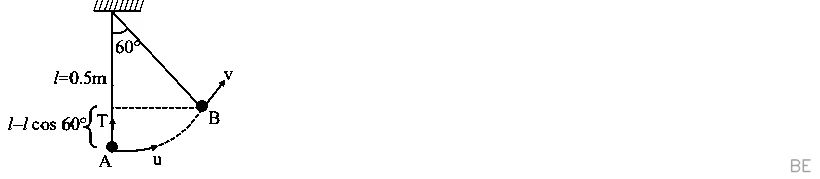
A pendulum bob has a speed of 3 m/s at its lowest position. The pendulum is 50 cm long. The speed of bob, when the length makes an angle of 60° to the vertical will be (g = 10 m/s ) ______ m/s.
The time period of a simple pendulum is given by . The measured value of the length of pendulum is known to a accuracy. The time for 200 oscillations of the pendulum is found to be 100 s using a clock of 1 s resolution. The percentage accuracy in the determination of using this pendulum is . The value of to the nearest integer is
A particle of mass is hanging from a spring of force constant . The mass is pulled slightly downward and released, so that it executes free simple harmonic motion with time period T. The time when the kinetic energy and potential energy of the system will become equal, is . The value of x is.
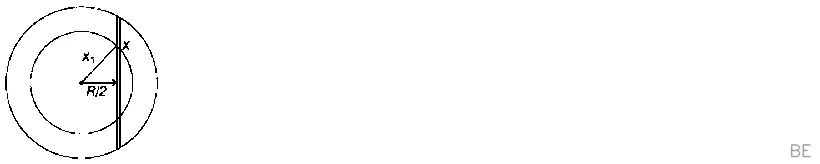
Assume that a tunnel is dug along a chord of the earth, at a perpendicular distance from the earth's centre, where is the radius of the earth. The wall of the tunnel is frictionless. If a particle is released in this tunnel, it will execute a simple harmonic motion with a time period?
A particle performs simple harmonic motion with a period of . The time taken by the particle to cover a displacement equal to half of its amplitude from the mean position is . The value of to the nearest integer is
Two particles and of equal masses are suspended from two massless springs of spring constants and , respectively. If the maximum velocities during oscillations are equal, the ratio of the amplitude of and is
For what value of displacement the kinetic energy and potential energy of a simple harmonic oscillation become equal?
A particle is making simple harmonic motion along the X-axis. If at a distances and from the mean position the velocities of the particle are and respectively. The time period of its oscillation is given as:
A particle starts executing simple harmonic motion (SHM) of amplitude 'a' and total energy . At any instant, its kinetic energy is then its displacement 'y' is given by:
is the time-displacement equation of SHM. At , the displacement of the particle is and it is moving along negative -direction. Then, the initial phase angle will be
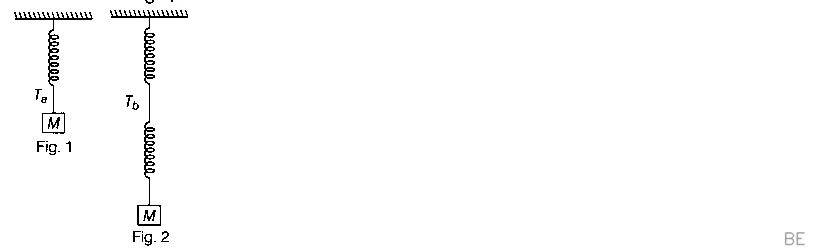
Consider two identical springs each of spring constant and negligible mass compared to the mass as shown. Fig.1 shows one of them and Fig.2 shows their series combination. The ratios of time period of oscillation of the two SHM is , where value of is ......... (Round off to the nearest integer)

The function of time representing a simple harmonic motion with a period of is
An object of mass is executing simple harmonic motion. It amplitude is and time period (T) is . What will be the potential energy of the object at an instant starting from mean position. Assume that the initial phase of the oscillation is zero.
Two identical springs of spring constant are attached to a block of mass and to fixed support (see figure). When the mass is displaced from equilibrium position on either side, it executes simple harmonic motion. The time period of oscillations of this system is

Two simple harmonic motion, are represented by the equations and Ratio of amplitude of to . The value of x is ............ .
Want unlimited AI-generated Oscillations questions?
Sign up free and practice with adaptive difficulty — Easy, Medium, Hard. New questions every session.
Start practising for free →