On the x-axis and a dsitance from the origin, the gravitational field due to a mass distribution is given by in the -direction. The magnitude of gravitational potential on the -axis at a distance taking its value to be zero at infinity, is :

JEE Main · Physics
Generate JEE Main level questions on Gravitation. Focus on Kepler's laws, Gravitational potential, and escape velocity.
205 questions · 20 PYQs · 0 AI practice · JEE Main 2027
On the x-axis and a dsitance from the origin, the gravitational field due to a mass distribution is given by in the -direction. The magnitude of gravitational potential on the -axis at a distance taking its value to be zero at infinity, is :

A ball is dropped from the top of a 100 m high 1 tower on a planet. In the last s before hitting the ground, it covers a distance of 19 m. Acceleration due to gravity (in ms) near the surface on that planet is ______
A box weighs 196 N on a spring balance at the north pole. Its weight recorded on the same balance if it is shifted to the equator is close to (Take g = 10 ms at the north pole and the radius of the earth = 6400 km):
An asteroid is moving directly towards the centre of the earth. When at a distance of 10R (R is the radius of the earth) from the earths centre, it has a speed of 12 km/s. Neglecting the effect of earths atmosphere, what will be the speed of the asteroid when it hits the surface of the earth (escape velocity from the earth is 11.2 km/s) ? Give your answer to the nearest integer in kilometer/s______
A body is moving in a low circular orbit about a planet of mass and radius The radius of the orbit can be taken to be itself. Then the ratio of the speed of this body in the orbit to the escape velocity from the planet is :
A satellite of mass m is launched vertically upwards with an initial speed u from the surface of the earth. After it reaches height R (R = radius of the earth), it ejects a rocket of mass so that subsequently the satellite moves in a circular orbit. The kinetic energy of the rocket is (G is the gravitational constant; M is the mass of the earth): [7-Jan-2020 Shift 1]
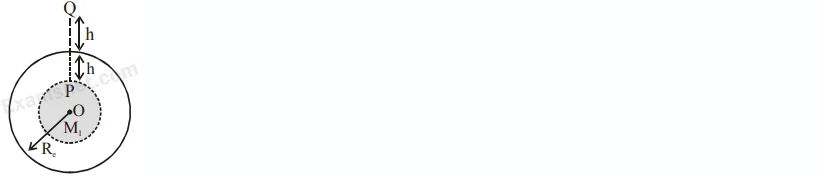
The value of the acceleration due to gravity is at a height radius of the earth from the surface of the earth. It is again equal to at a depth below the surface of the earth. The ratio equals
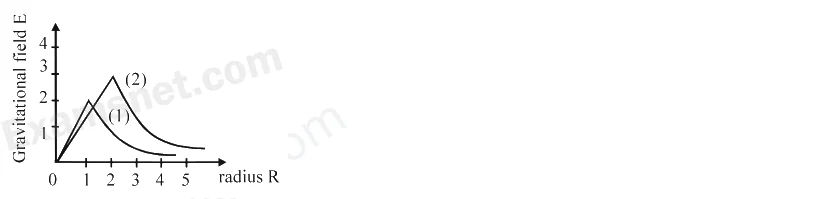
Consider two solid spheres of radii , and masses and , respectively. The gravitational field due to sphere (1) and (2) are shown. The value of is :

PHYSICS A satellite is in an elliptical orbit around a planet P. It is observed that the velocity of the satellite when it is farthest from the planet is 6 times less than that when it is closest to the planet. The ratio of distances between the satellite and the planet at closest and farthest points is :
The acceleration due to gravity on the earth's surface at the poles is and angular velocity of the earth about the axis passing through the pole is An object is weighed at the equator and at a height h above the poles by using a spring balance. If the weights are found to be same, then is where is the radius of the earth)
The height 'h' at which the weight of a bodywill be the same as that at the same depth 'h'from the surface of the earth is (Radius of theearth is and effect of the rotation of the earthis neglected):
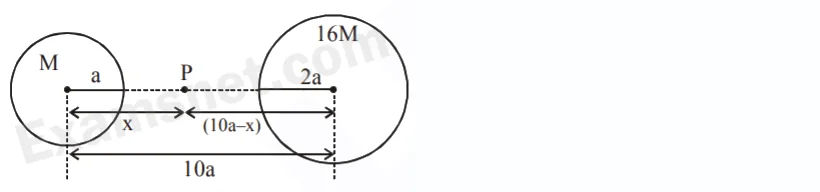
Two planets have masses and and their radii are a and 2a, respectively. The separation between the centers of the planets is 10a. A body of mass is fired from the surface of the larger planet towards the smaller planet along the line joining their centers. For the body to be able to reach at the surface of smaller planet, the minimum firing speed needed is :
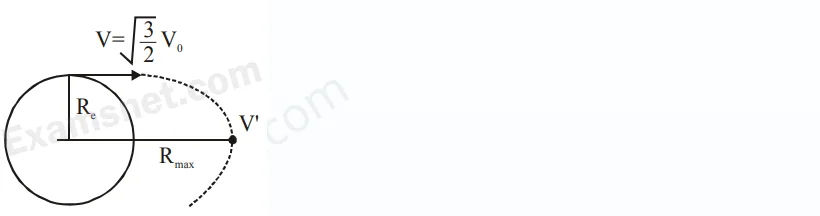
A satellite is moving in a low nearly circular orbit around the earth. Its radius is roughly equal to that of the earth's radius By firing rockets attached to it, its speed is instantaneously increased in the direction of its motion so thatis become times larger. Due to this the farthest distance from the centre of the earth that the satellite reaches is value of is :
The mass density of a spherical galaxy variesas over a large distance 'r' from its centre. In that region, a small star is in a circular orbitof radius . Then the period of revolution, depends on as :
The mass density of a planet of radius varies with the distance from its centre as Then the gravitational fieldis maximum at:
Planet A has mass M and radius R. Planet B has half the mass and half the radius of Planet A. If the escape velocities from the Planets A and B are and , respectively, then , The value of n is :
A body A of mass m is moving in a circular orbit of radius R about a planet. Another body B of mass collides with A with a velocity which is half the instantaneous velocity of A. The collision is completely inelastic. Then, the com bined body :
The ratio of the weight of a body on the Earth's surface to that on the surface of a planet is 9 : 4 , the mass of the planet is th of that of the Earth. If 'R' is the radius of the Earth, what is the radius of the planet? (Take the planets to have the same mass density)
Two stars of masses 3 × kg each, and at distance 2 × m rotate in a plane about their common centre of mass O. A meteorite passes through O moving perpendicular to the star's rotation plane. In order to escape from the gravitational field of thisdouble star, the minimum speed that meteorite should have at O is : (Take Gravitational constant G = 6.67 ×
A satellite of mass M is in a circular orbit ofradius R about the centre of the earth. Ameteorite of the same mass, falling towards theearth, collides with the satellite completelyinelastically. The speeds of the satellite and themeteorite are the same, just before the collision.The subsequent motion of the combined bodywill be :
Want unlimited AI-generated Gravitation questions?
Sign up free and practice with adaptive difficulty — Easy, Medium, Hard. New questions every session.
Start practising for free →