Q221JEE Main 2019MCQ
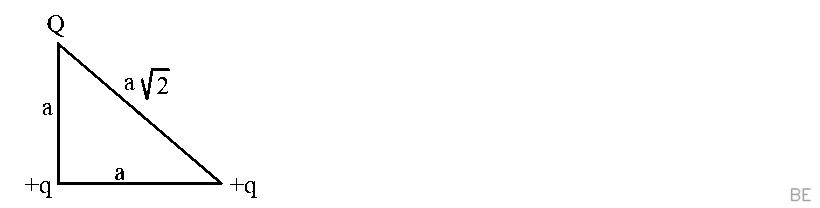
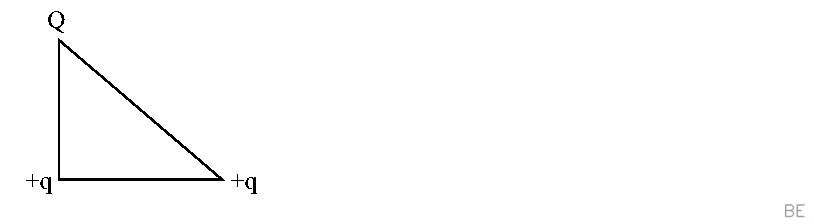
The charges Q + q and +q are placed at thevertices of a right-angle isosceles triangle asshown below. The net electrostatic energy ofthe configuration is zero, if the value of Q is :
JEE Main · Physics
Generate JEE Main level questions on Electrostatics. Focus on Coulomb's law, Electric field, and Gauss's theorem.
280 questions · 20 PYQs · 0 AI practice · JEE Main 2027
The charges Q + q and +q are placed at thevertices of a right-angle isosceles triangle asshown below. The net electrostatic energy ofthe configuration is zero, if the value of Q is :
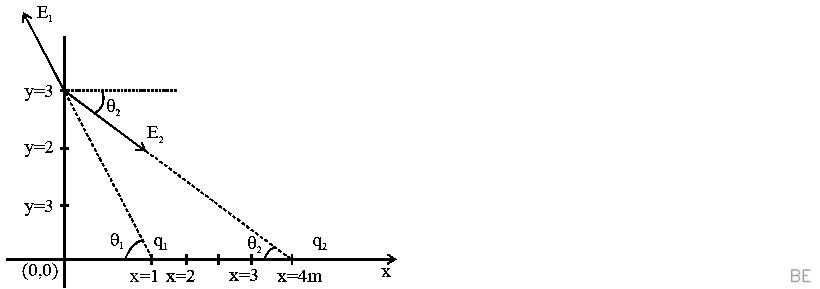
Two point charges and are placed on the x-axis at and respectively. The electric field (in V/m) at a point on y-axis is,
For a uniformly charged ring of radius R, theelectric field on its axis has the largestmagnitude at a distance h from its centre. Thenvalue of h is : [9-Jan-2019 Shift 1]
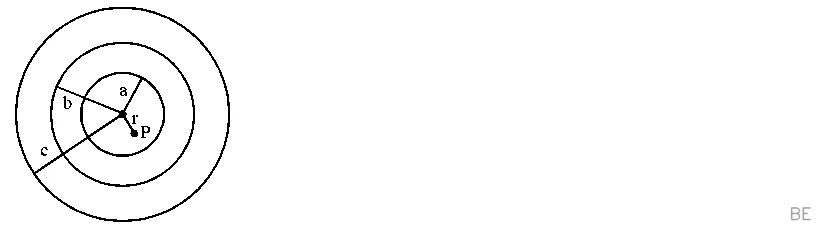
A charge Q is distributed over three concentricspherical shells of radii a, b, c (a < b < c ) suchthat their surface charge densities are equal toone another. The total potential at a point atdistance r from their common centre, wherer < a, would be :
In free space, a particle A of charge is held fixed at a point P. Another particle B of the same charge and mass is kept at a distance of 1 mm from P. If B is released, then its velocity at a distance of 9 mm from P is: {Take }
A positive point charge is released from rest at a distance from a positive line charge with uniform density. The speed ( v) of the point charge, as a function of instantaneous distance r from line charge, is proportional to :

A point dipole is kept at the origin. The potential and electric field due to this dipole on the y - axis at a distance d are, respectively. (Take V = 0 at indignity)
Two electric dipoles, A, B with respectivedipole moments and placed on the x - axis with a separation R , as shown in the figure The distance from A at which both of themproduce the same potential is :

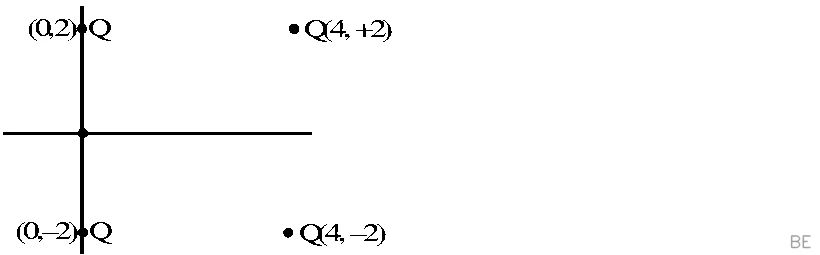
Four equal point charges Q each are placed inthe xy plane at (0, 2), (4, 2), (4, -2) and (0, -2).The work required to put a fifth charge Q at theorigin of the coordinate system will be :
Three charges +Q, q, + Q are placed respectively, at distance, 0, d/2 and d from the origin, on the x-axis. If the net force experienced by + Q, placed at x = 0, Ls zero, then value of q is : [9-Jan-2019 Shift 1]
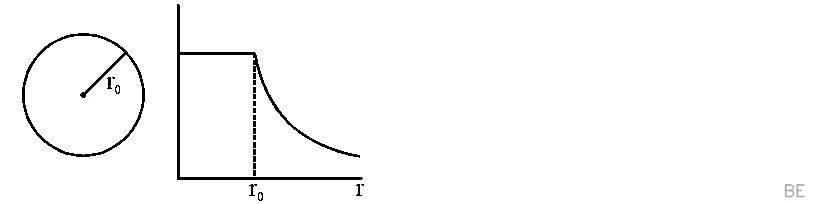
The given graph shows variation (with distancer from centre) of :
A uniformly charged ring of radius and total charge is placed in -plane centred at orign. A point charge is moving towards the ring along the -axis and has speed at . The minimum value of such that it crosses the origin is:
Shown in the figure is a shell made of a conductor. It has inner radius a and outer radius b, and carries charge Q. At its centre is a dipole as shown. In this case:

A solid ball of radius has a charge density given by for . The electric field outside the ball is :
Three concentric metal shells A,B and C of respective radii a,b and c have surface charge densities and respectively. The potential of shell B is :[Main 8 April 2018]
A charge Q is placed at a distance a/2 above the centre of the square surface of edge a as shown in the figureThe electric flux through the square surface is :[Main 15 April 2018 S1]

Two identical conducting spheres A and B, carry equal charge. They are separated by a distance much larger than their diameters, and the force between them is F. A third identical conducting sphere, C,is uncharged. Sphere C is first touched to A, then to B, and then removed. As a result, the force between A and B would be equal to :[Main 16 April 2018 S1]
A body of mass M and charge q is connected to a spring of spring constant k. It is oscillating along x-direction about its equilibrium position, taken to be at , with an amplitude A. An electric field E is applied along the x-direction. Which of the following statements is correct ?[Main 15 April 2018 S1]
Four closed surfaces and corresponding charge distributions are shown below.Let the respective electric fluxes throughthe surfaces be and Φ4. Then :[Main 9 April 2017]

There is a uniform electrostatic field in a region. The potential at various points on a small sphere centred at P, in the region,is found to vary between the limits 589.0 V to 589.8 V. What is the potential at a point on the sphere whose radius vector makes an angle of 608 with the direction of the field ?[Main 8 April 2017]
Want unlimited AI-generated Electrostatics questions?
Sign up free and practice with adaptive difficulty — Easy, Medium, Hard. New questions every session.
Start practising for free →