Q41JEE Main 2020MCQ
Two particles of equal mass have respective initial velocities and . They collide completely inelastically. The energy lost in the process is:
JEE Main · Physics
Generate JEE Main level questions on Centre of Mass and Collision. Focus on Momentum conservation and Coefficient of restitution.
100 questions · 20 PYQs · 0 AI practice · JEE Main 2027
Two particles of equal mass have respective initial velocities and . They collide completely inelastically. The energy lost in the process is:
The coordinates of centre of mass of a uniform flag shaped lamina (thin flat plate) of mass 4kg. (The coordinates of the same are shown in figure) are :

A block of mass slides with velocity on a frictionless horizontal surfaceand collides with a uniform vertical rod andsticks to it as shown. The rod is pivoted about and swings as a result of the collision making angle before momentarily coming to rest. If the rod has mass and length the value of is approximately :(Take

A block of mass is at rest at the edge of a table, of height . A bullet of mass collides with the block and sticks to it. If the velocity of the bullet is in the horizontal direction just before the collision then the kinetic energy just before the combined system strikes the floor, is $[Take . Assume there is no rotational motion and loss of energy after the collision is negligable.]$
A particle of mass m is dropped from a height h above the ground. At the same time another particle of the same mass is thrown vertically upwards from the ground with a speed of . If they collide head-on completely inelastically, the time taken for the combined mass to reach the ground, in units of is:
A body A, of mass m = 0.1 kg has an initial velocity of . It collides elastically with another body, B of the same mass which has an initial velocity of . After collision, A moves with a velocity . The energy of B after collision is written as . The value of x is
A particle of mass m is projected with a speed u from the ground at an angle w.r.t. horizontal (x-axis). When it has reached its maximum height, it collides completely inelastically with another particle of the same mass and velocity . The horizontal distance covered by the combined mass before reaching the ground is:
Three point particles of masses 1.0 kg, 1.5 kg and 2.5 kg are placed at three corners of a right angle triangle of sides 4.0 cm, 3.0 cm and 5.0 cm as shown in the figure. The center of mass of the system is at a point: [7-Jan-2020 Shift 1]

Particle A of mass moving with velocity collides with another particle of mass which is at rest initially. Let and be the velocities of particles and after collision respectively. If and after collision the angle between and is :
The centre of mass of a solid hemisphere of radius is from the centre of the flat surface. Then value of is
A particle of mass with an initial velocity collides perfectly elastically with a mass at rest. It moves with a velocity after collision, then, is given by :
A s shown in figure, when a spherical cavity (centred at O) of radius 1 is cut out of a uniform sphere of radius R (centred at C), the centre of mass of remaining (shaded) part of sphere is at G, i.e, on the surface of the cavity. R can be detemined by the equation :

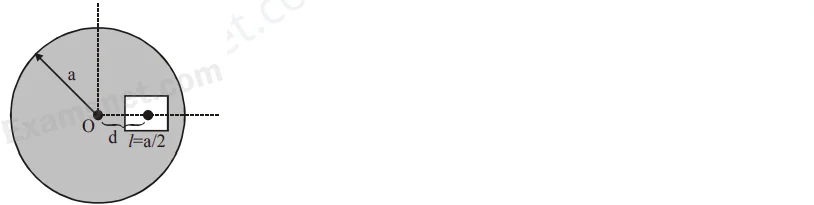
A square shaped hole of side is carvedout at a distance from the centre 'O' ofa uniform circular disk of radius a. If thedistance of the centre of mass of the remainingportion from is value of (to thenearest integer) is ______.
Two bodies of the same mass are moving with the same speed, but in different directions in a plane. They have a completely inelastic collision and move together thereafter with a final speed which is half of their initial speed. The angle between the initial velocities of the two bodies (in degree) is.
A rod of length L has non-uniform linear mass density given by , where a and b are constants and The value of x for the centre of mass of the rod is at :
A particle of mass is moving along the -axis with initial velocity undefined . It collides elastically with a particle of mass at rest and then moves with half its initial kinetic energy (see figure). If then value of is _____.

Blocks of masses and are arranged in a line on a frictionless floor. Another block of mass moving with speed along the same line (see figure) collides with mass in perfectly inelastic manner. All the subsequent collisions are also perfectly inelastic. By the time the last block of mass starts moving the total energy loss is p% of the original energy. Value of 'p' is close to :

Two masses m and are connected at the two ends of a massless rigid rod of length . The rod is suspended by a thin wire of torsional constant k at the centre of mass of the rod-mass system(see figure). Because of torsional constant k, the restoring torque is for angular displacement θ. If the rod is rotated by and released, the tension in it when it passes through it mean position will be: [9-Jan-2019 Shift 1]

A particle of mass 'm' is moving with speed ''and collides with a mass '2m' moving with speed ' ' in the same direction. After collision, the first mass is stopped completely while the second one splits into two particles each of mass 'm', which move at angle 45° with respect to the original direction. The speed of each of the moving particle will be:
An alpha-particle of mass m suffers 1-dimensional elastic coolision with a nucleus at rest of unknown mass. It is scattered directly backwards losing, 64% of its initial kinetic energy. The mass of the nucleus is :-
Want unlimited AI-generated Centre Of Mass And Collision questions?
Sign up free and practice with adaptive difficulty — Easy, Medium, Hard. New questions every session.
Start practising for free →


