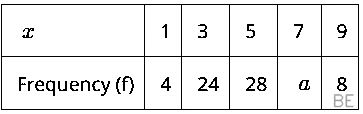
Let the Mean and Variance of five observations x1=1,x2=3,x3=a,x4=7 and x5=b,a>b, be 5 and 10 respectively. Then the Variance of the observations n+xn,n=1.2,…,5 is
📖 Explanation
Variance represents the dispersion of a data distribution, determined by subtracting the square of the mean from the average of the squared observations. The sum of the given observations is defined by the mean of 5 across five terms, leading to the equation 1+3+a+7+b=25, which simplifies to a+b=14. Incorporating the given variance of 10 into the standard formula requires the sum of the squares, resulting in the equation 51+9+a2+49+b2−25=10. Rearranging this expression provides a2+b2=116, and solving this system alongside the sum equation with the constraint a>b confirms the values a=10 and b=4.
The modified observations, created by adding the index n to each term, yield the sequence 2, 5, 13, 11, 9. The mean of this new sequence is calculated as 8. To find the variance, compute the difference between the mean of the squares of these observations and the square of the mean:
522+52+132+112+92−82
Evaluating this expression results in 54+25+169+121+81−64, which simplifies to 80−64=16.