Rewriting the expression cos(x+π/4)cot3x−tanx as tan3xcos(x+π/4)1−tan4x simplifies the analysis as x approaches π/4 because tanx approaches 1. Factoring the numerator 1−tan4x into (1−tan2x)(1+tan2x) and expanding the denominator cos(x+π/4) as 2cosx−sinx helps reveal the shared algebraic terms. Since cosx−sinx is equivalent to cosx(1−tanx), one can cancel the common (1−tanx) factor from the numerator expression (1−tanx)(1+tanx)(1+tan2x). The simplified expression tan3xcosx2(1+tanx)(1+tan2x) evaluates to 8 when substituting x=π/4.
Q202JEE Main 2019MCQ
Let K be the set of all real values of x where the function f(x) = sin |x| - |x| + 2(x - π) cos |x| is not differentiable. Then the set K is equal to :-
The differentiability of a function requires that the left-hand and right-hand derivatives be equal at any point where the definition potentially changes. For the function f(x)=sin∣x∣−∣x∣+2(x−π)cos∣x∣, the only candidate for non-differentiability is x=0 due to the presence of absolute value terms. Analyzing the component sin∣x∣−∣x∣, the right-hand derivative at x=0 is cos(0)−1=0, while the left-hand derivative is −cos(0)+1=0; since these match, this part of the function is differentiable at the origin. Furthermore, the term 2(x−π)cos∣x∣ simplifies to 2(x−π)cosx because the cosine function is symmetric, and being a product of differentiable functions, it remains smooth everywhere. Consequently, the function has no points where it fails to be differentiable, meaning the set K is equal to Φ.
Q203JEE Main 2019MCQ
Let f:R→R be differentiable at c∈R and f(c)=0. If g(x)=∣f(x)∣, then at x=c,g is
The differentiability of the composite function g(x)=∣f(x)∣ at a point x=c where f(c)=0 relies entirely on the slope of the original function at that location. By examining the expression g′(x)=f(x)∣f(x)∣f′(x), we can see that if f′(c)=0, the slope approaches zero from both the left and right directions, effectively allowing the derivative to exist. This demonstrates that the function is differentiable when f′(c)=0.
Q204JEE Main 2019MCQ
Let f (x) =
{max{∣x∣,x2},8−2∣x∣,∣x∣≤22<∣x∣≤4
Let S be the set of points in the interval (-4,4)at which f is not differentiable. Then S:
A function is not differentiable at points where the graph displays sharp corners or where adjacent segments join with differing derivatives. The expression can be represented piecewise by comparing the magnitudes of ∣x∣ and x2, yielding f(x)=8+2x on [−4,−2), x2 on [−2,−1], ∣x∣ on (−1,1), x2 on [1,2], and 8−2x on (2,4].
The boundaries reveal that the derivatives do not align across these transitions. At x=−2, the slope changes from 2 to -4, and at x=−1, it transitions from -2 to -1. The point x=0 is a corner where the slope shifts from -1 to 1, while at x=1, it moves from 1 to 2, and at x=2, it drops from 4 to -2. These mismatches in the derivative at x=−2,−1,0,1,2 define the set of points where the function is not differentiable.
Q205JEE Main 2019MCQ
Let f:[−1,3]⇒R be defined as
f(x)=⎩⎨⎧∣x∣+[x]x+[x]x+[x]−1≤x<11≤x<22≤x≤3
where [t] denotes the greatest integer less than or equal to t. Then, f is discontinuous at:
Continuity at a specific point requires the left-hand limit, the right-hand limit, and the function value to be identical. Examining the function f(x) over [−1,3], we analyze its behavior across the defined sub-intervals: f(x)=−x−1 for −1≤x<0, f(x)=x for 0≤x<1, f(x)=2x for 1≤x<2, f(x)=x+2 for 2≤x<3, and f(3)=6.
At x=0, the left-hand limit limx→0−f(x)=−1 differs from the right-hand limit limx→0+f(x)=0, establishing a jump discontinuity. At x=1, the left-hand limit limx→1−f(x)=1 is distinct from the right-hand limit limx→1+f(x)=2, identifying a second point of discontinuity. The function remains continuous at x=2 because limx→2−f(x)=4 and limx→2+f(x)=4, but at x=3, the left-hand limit limx→3−f(x)=5 does not equal the function value f(3)=6, creating a third discontinuity. Because these are the only points where continuity conditions are violated, the function is discontinuous at only three points.
Q206JEE Main 2019MCQ
Let S be the set of all points in (-π,π) at which the function, f(x) = min {sinx, cosx} is not differentiable. Then S is a subset of which of the following?
The function f(x)=min(sinx,cosx) is non-differentiable at points where the graphs of sinx and cosx intersect, provided their derivatives are unequal at those intersections. Setting sinx=cosx yields tanx=1, which corresponds to x=4π+nπ for any integer n. Restricting these points to the open interval (−π,π) gives x=4π (for n=0) and x=−43π (for n=−1). Since the derivative of sinx is cosx and the derivative of cosx is −sinx, evaluating these at the intersection points shows the derivatives are unequal (21=−21 and −21=21), confirming non-differentiability at these two values. Thus, the set of non-differentiable points is S={−43π,4π}, which is a subset of {−43π,−4π,43π,4π}.
Q207JEE Main 2019MCQ
If limlimitsx→1x−1x4−1=limlimitsx→kx2−k2x3−k3; then k is
Indeterminate forms of the type 0/0 are best resolved by factoring expressions to cancel the terms that cause the division by zero. For the expression on the left, recognizing the numerator x4−1 as a product of (x−1) and the polynomial (x3+x2+x+1) allows us to cancel the denominator and evaluate the limit as 4 by substituting x=1.
For the expression on the right, factoring the difference of cubes x3−k3 into (x−k)(x2+xk+k2) and the difference of squares x2−k2 into (x−k)(x+k) allows the (x−k) terms to cancel. Evaluating the resulting fraction x+kx2+xk+k2 as x approaches k simplifies to 2k3k2, which reduces to 23k. Equating the two limits gives 23k=4, resulting in k=38.
Q208JEE Main 2019MCQ
Let f (x) =
{−1x2−1−2≤x<00≤x≤2
and g (x) = |f (x)| + f (|x|) . Then, in the interval (-2, 2), g is :-
The differentiability of a function at a specific point requires both continuity and the equality of the left-hand and right-hand derivatives. For a piecewise defined function, we must examine the behavior at every transition point to identify where the slope changes abruptly.
First, consider the term f(∣x∣) for x∈[−2,2]. Because the absolute value ∣x∣ maps to the non-negative range [0,2], we consistently use the second piece of the definition, f(∣x∣)=∣x∣2−1, which simplifies to x2−1. Next, determine ∣f(x)∣ by taking the absolute value of the original pieces, noting that x2−1 changes sign at x=1. This yields ∣f(x)∣=1 for x∈[−2,0), ∣f(x)∣=1−x2 for x∈[0,1), and ∣f(x)∣=x2−1 for x∈[1,2].
Combining these results into g(x)=∣f(x)∣+f(∣x∣) provides the piecewise definition:
$
g(x)=⎩⎨⎧x202(x2−1)x∈[−2,0)x∈[0,1)x∈[1,2]
Checkingthecriticalpointsforcontinuity,thefunctionapproaches0frombothsidesatx=0andatx=1,confirmingthefunctioniscontinuouseverywhere.Finally,evaluatingthederivativeatx=1,thederivativeoftheleftpieceis0,whilethederivativeoftherightpiece,2x^2 - 2,is4x.Atx=1,thisright−handderivativeis4.Sincetheleft−handderivative0doesnotequaltheright−handderivative4$, the function is not differentiable at this point.
Q209JEE Main 2019MCQ
For each x ∊ R, let [x] be the greatest integer lessthan or equal to x. Then limlimitsx→0−∣x∣x([x]+∣x∣)sin[x] is equal to
When the variable x approaches 0 from the negative side, the greatest integer function [x] is fixed at −1, while the absolute value function ∣x∣ is defined as −x. Substituting these values into the expression ∣x∣x([x]+∣x∣)sin[x] yields the simplified form −xx(−1−x)sin(−1). Canceling the term −x from the denominator with the corresponding factors in the numerator simplifies the expression to (1+x)sin(−1), which is equivalent to −(1+x)sin1. Evaluating the limit as x→0 leads directly to the result −sin1.
Q210JEE Main 2019MCQ
Let f : (-1,1) → R be a function defined by f (x) = max {- |x| , - 1−x2}. If K be the set ofall points at which f is not differentiable, thenK has exactly :
The non-differentiable points of f(x)=max{−∣x∣,−1−x2} are identified by analyzing both the inherent non-differentiability of its components and the locations where they intersect. First, the component −∣x∣ is non-differentiable at x=0, establishing this as the first point of concern. Second, the two functions intersect where −∣x∣=−1−x2, which simplifies to ∣x∣=1−x2 and leads to x2=1−x2, or 2x2=1, yielding the points x=21 and x=−21. Since the derivatives of the two components differ at these intersection points, the function f(x) fails to be differentiable there as well. Consequently, there are exactly three points of non-differentiability within the interval (−1,1).
Q211JEE Main 2019MCQ
Let f:R⇒R be a differentiable function Satisfying f′(3)+f′(2)=0. Then limlimitsx⇒0(1+f(2−x)−f(2)1+f(3+x)−f(3))x1 is equal to
Limits involving a variable exponent that approach the indeterminate form 1∞ can be evaluated by applying the identity limx→a[g(x)]h(x)=elimx→ah(x)[g(x)−1]. Applying this property to the expression limx→0(1+f(2−x)−f(2)1+f(3+x)−f(3))x1 involves subtracting one from the base, which simplifies the inner term to 1+f(2−x)−f(2)f(3+x)−f(3)−f(2−x)+f(2). Multiplying this result by the exponent x1 allows for the application of the limit as x approaches zero.
The expression within the exponent then becomes x1(1+f(2−x)−f(2)f(3+x)−f(3)−1+f(2−x)−f(2)f(2−x)−f(2)). As x tends to zero, the term xf(3+x)−f(3) approaches the derivative f′(3). Similarly, the term xf(2−x)−f(2) can be rewritten as −−xf(2−x)−f(2), which approaches −f′(2). Since the denominator 1+f(2−x)−f(2) approaches 1, the limit of the entire exponent simplifies directly to f′(3)−(−f′(2)), which is f′(3)+f′(2). Given the condition f′(3)+f′(2)=0, the calculation results in e0, giving a final value of 1.
A function is continuous at x=0 if limx→0−f(x)=limx→0+f(x)=f(0). Evaluating the left-hand limit, the expression becomes: limx→0−xsin(p+1)x+sinx=limx→0−(xsin(p+1)x+xsinx)=(p+1)+1=p+2
The right-hand limit is evaluated by factoring x from the numerator: limx→0+x3/2x2+x−x=limx→0+xxx(x+1−1)=limx→0+xx+1−1
Multiplying by the conjugate x+1+1x+1+1 further yields: limx→0+x(x+1+1)(x+1)−1=limx→0+x+1+11=21
Equating these results to f(0)=q, we find p+2=21 and q=21, which results in p=−23 and q=21.
Rationalization is the most effective approach for resolving the indeterminate form encountered at y=0. Multiplying the numerator and denominator by the conjugate of the numerator, 1+1+y4+2, simplifies the numerator to 1+y4−1. Next, rationalize this new numerator by multiplying the entire expression by 1+y4+11+y4+1, which simplifies the numerator to 1+y4−1, or y4. Since this y4 cancels out the y4 term in the denominator, you are left with the expression (1+1+y4+2)(1+y4+1)1. Evaluating this at y=0 yields (1+1+2)(1+1)1, which simplifies to (2+2)(2)1, resulting in the final value of 421.
Rationalization is the primary technique for resolving indeterminate forms involving radicals, as multiplying the numerator and denominator by the conjugate x2+2sinx+1+sin2x−x+1 allows for the simplification of the denominator. Performing this operation transforms the expression into x2+2sinx−sin2x+x(x+2sinx)(x2+2sinx+1+sin2x−x+1). As x approaches 0, the dominant linear terms in the denominator reduce to 2sinx+x, while the numerator simplifies by substituting the small-angle approximation sinx≈x. Consequently, the denominator becomes 2x+x=3x, and the numerator becomes (x+2x)(1+1), which equals 3x⋅2=6x. Dividing these results, 3x6x, yields a final limit of 2.
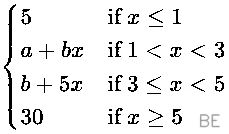
A function is continuous at any point if the left-hand limit, the right-hand limit, and the function value are all equivalent at that point. To determine if this function is continuous, we must ensure these conditions are met at the transition points x=1, x=3, and x=5. At x=1, the left-hand limit is 5 and the right-hand limit is a+b, which necessitates a+b=5. At x=5, the left-hand limit is b+5(5) and the function value is 30, which leads to the equation b+25=30, meaning b=5.
Substituting b=5 into the first equation yields a=0. We must now verify if these values satisfy the continuity condition at x=3, where the left-hand limit is a+3b and the right-hand limit is b+5(3), or b+15. With a=0 and b=5, the left-hand limit results in 0+3(5)=15, while the right-hand limit results in 5+15=20. Because 15=20, the function cannot be continuous at x=3 for any values of a and b.
Q216JEE Main 2019MCQ
If f(x)=[x]−[4x],x∈R , where [x] denotes the greatest integer function, then:
A function is continuous at a specific point if the limit as the variable approaches that point from the left and the right equals the function's actual value at that point. We determine the status of f(x)=[x]−[4x] at x=4 by evaluating these three conditions to see if they converge to the same result.
When x approaches 4 from the right, [x] is 4 and [4x] is 1, leading to a limit of 4−1=3. Approaching from the left, x is slightly less than 4, so [x] evaluates to 3 and [4x] becomes 0, which also results in 3−0=3. Since the direct evaluation at f(4) yields 4−1=3, the limits from both sides match the function value, confirming that the function is continuous at x=4.
Q217JEE Main 2019MCQ
If limlimitsx→1x−1x2−ax+b=5, then a+b is equal to
For the limit of this rational function to exist as a finite value, the numerator must vanish at x=1 since the denominator is already zero. Substituting x=1 into the numerator gives 12−a(1)+b=0, which simplifies to 1−a+b=0. To resolve the indeterminate form, differentiating the numerator and denominator with respect to x yields the expression 12x−a, which must equate to the limit value of 5 at x=1, resulting in the equation 2−a=5.
Solving 2−a=5 gives a=−3, and inserting this value into the previous equation 1−(−3)+b=0 reveals that b=−4. Finally, adding these two coefficients together, a+b equals −3+(−4), which results in -7.
Rationalizing the numerator by multiplying by the conjugate π+2sin−1x transforms the expression into 1−x(π+2sin−1x)π−2sin−1x. Noting that 2π−sin−1x=cos−1x, the numerator simplifies to 2cos−1x, while the term in the denominator π+2sin−1x approaches 2π as x→1−, leaving the expression as 2π1limx→1−1−x2cos−1x.
Substituting x=cosθ, where θ→0+ as x→1−, transforms the remaining limit into 1−cosθ2θ=2sin2(θ/2)2θ=2sin(θ/2)2θ. Applying the fundamental limit limθ→0sin(θ/2)θ=2, the calculation yields 2π1⋅22, which simplifies to π2.
Q219JEE Main 2018MCQ
If the function f defined as f(x)=x1−e2x−1k−1,x=0,is continuous at x=0,then the ordered pair (k,f(0)) is equal[Main 16 April 2018 S1]
A function f(x) is continuous at x=0 if limx→0f(x)=f(0). Rewriting the function as f(x)=x(e2x−1)e2x−1−x(k−1), the limit exists only if the numerator approaches zero as x→0. Using the Taylor series expansion for the exponential function, e2x=1+2x+2x2+…, the expression becomes x(2x+2x2)1+2x+2x2−1−kx+x=2x2+2x3x(3−k)+2x2.
To ensure a finite limit exists, the coefficient of the lowest power of x in the numerator must be zero, as the denominator is of order x2. Setting the numerator term x(3−k) to zero yields 3−k=0, implying k=3. Substituting k=3 into the simplified expression results in limx→02x22x2=1, which defines the value f(0)=1. Thus, the ordered pair is (k,f(0))=(3,1).
Q220JEE Main 2018MCQ
limlimitsx→09−(27+x)1/3(27+x)1/3−3 equals to:[Main 16 April 2018 S1]
The substitution method simplifies limits containing radicals by converting the expression into a more manageable algebraic form. Defining t=(27+x)1/3 implies that t3=27+x, and as x approaches 0, t approaches 3. Using the standard form of this limit problem, which is limx→09−(27+x)2/3(27+x)1/3−3, the expression is transformed into limt→39−t2t−3. Factoring the denominator as 9−t2=−(t2−9)=−(t−3)(t+3), the expression becomes limt→3−(t−3)(t+3)t−3. Canceling the common factor (t−3) results in limt→3−t+31, which evaluates to −3+31=−61.
Want unlimited AI-generated Limits Continuity And Differentiability questions?
Sign up free and practice with adaptive difficulty — Easy, Medium, Hard. New questions every session.