The osmotic pressure of a solution of is 0.10 atm and that of a glucose solution is 0.20 atm. The osmotic pressure of a solution formed by mixing of the sodium chloride solution with of the glucose solutionis atm. is _____. (nearest integer) :-
JEE Main · Chemistry
Generate JEE Main level questions on Solutions. Focus on Raoult's law, Colligative properties, and Van't Hoff factor.
195 questions · 20 PYQs · 0 AI practice · JEE Main 2027
The osmotic pressure of a solution of is 0.10 atm and that of a glucose solution is 0.20 atm. The osmotic pressure of a solution formed by mixing of the sodium chloride solution with of the glucose solutionis atm. is _____. (nearest integer) :-
At 35°C, the vapour pressure of is 512 mm Hg and that of acetone is 344 mm Hg. A solution of in acetone has a total vapour pressure of 600 mm Hg. The false statement amongst the following is : [7-Jan-2020 Shift 1]
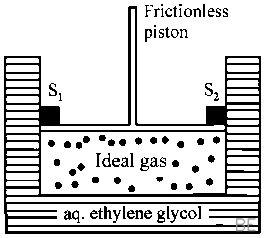
A cylinder containing an ideal gas (0.1 mol of 1.0 ) is in thermal equilibrium with a large volume of 0.5 molal aqueous solution of ethylene glycol at its freezing point. If the stoppers and (as shown in the figure) are suddenly withdrawn, the volume of the gas in litres after equilibrium is achieved will be____. (Given, (water) , )

A solution containing 62 g ethylene glycol in 250 g water is cooled to - 10°C. If for water is 1.86 K kg , the amount of water (in g) separated as ice is :
Which one of the following statements regarding Henry's law not correct ? [9-Jan-2019 Shift 1]
Elevation in the boiling point for 1 molal solution of glucose is 2 K. The depression in the freezing point of 2 molal solutions of glucose in the same solvent is 2 K. The relation between and is:
The osmotic pressure of a dilute solution of an ionic compound XY in water is four times that of a solution of 0.01 M in water. Assuming complete dissociation of the given ionic compounds is water, the concentration of XY (in mol L ) in solution is
is 40% ionised in aqueous solution. The value of its van't Hoff factor (i) is :-
Liquid 'M' and liquid 'N' form an ideal solution. The vapour pressures of pure liquids 'M' and 'N' are 450 and 700mmHg, respectively, at the same temperature. Then correct statement is: ( = Mole fraction of 'M' is solution; = Mole fraction of 'N' in solution ; = Mole fraction of 'M' in vapour phase; = Mole fraction of 'N' in vapour phase)
Molecules of benzoic acid () dimerise in benzene. 'w' g of the acid dissolved in 30 g of benzene shows a depression in freezing point equal to 2K. If the percentage association of the acid to form dimer in the solution is 80, then w is : (Giventhat = 5 K kg , Molar mass of benzoic acid = 122 g )
A solution is prepared by dissolving 0.6 g of urea ( molar mass =60 g mol) and 1 .8 g of glucose (molar mass =180 g mol) in 100 mL of water at 27°C . The osmotic pressure of the solution is :
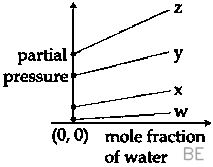
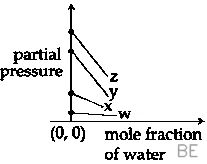
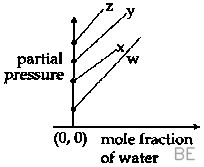
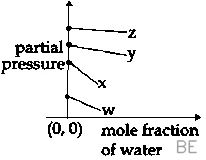
For the solution of the gases w, x, y and z in water at 298 K, the Henrys law constants are 0.5, 2, 35 and 40 kbar, respectively. The correct plot for the given data is :


Liquids A and B form an ideal solution in the entire composition range. At 350 K, the vapor pressures of pure A and pure B are 7 × Pa and 12 × Pa, respectively. The composition of the vapor in equilibrium with a solution containing 40 mole percentof A at this temperature is :
Freezing point of a 4% aqueous solution of X is equal to freezing point of 12% aqueous solution of Y. If molecular weight of X is A, then molecular weight of Y is :-
1 g of a non-volatile non - electrolyte solute is dissolved in 100 g of two different solvents A and B whose ebulliscopic constants are in the ratio of 1:5. The ratio of the elevation in their boiling points, , is :
At room temperature a dilute solution of urea is prepared by dissolving 0.60g of urea in 360g of water . If the vapour pressure of pure water at this temperature is 35mmHg , Lowering of vapour pressure will be (molar mass of urea =60g )
The freezing point of a diluted milk sample is found to be -0.2°C, while it should have been -0.5°C for pure milk. How much water has been added to pure milk to make the diluted sample ?
The vapour pressures of pure liquids A and B are 400 and 600 mmHg, respectively at 298 K. On mixing the two liquids, the sum of their initial volumes is equal to the volume of the final mixture. The mole fraction of liquid B is 0.5 in the mixture. The vapour pressure of the final solution, the mole fractions of components A and B in vapour phase, respectively are:
Molal depression constant for a solvent is 4.0 K kg . The depression in thefreezing point of the solvent for 0.03 mol solution of is : (Assumecomplete dissociation of the electrolyte).
For 1 molal aqueous solution of the following compounds, which one will show the highest freezing point?[Main 8 April 2018]
Want unlimited AI-generated Solutions questions?
Sign up free and practice with adaptive difficulty — Easy, Medium, Hard. New questions every session.
Start practising for free →