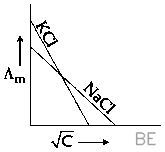
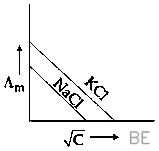
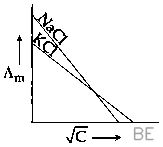
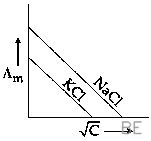
Let CNaCl and CBaSO4 be the conductances (in S ) measured for saturated aqueous solutions ofNaCl and BaSO4, respectively, at a temperatureT. Which of the following is false?
📖 Explanation
Electrolytic conductance in a saturated solution is determined by the total concentration of dissolved ions and the speed at which those ions can move through the solvent. For highly soluble salts like NaCl, the concentration of ions remains substantial, and increasing the temperature significantly enhances the ionic mobility of the ions, leading to an increase in conductance. Thus, as the temperature rises from T1 to T2, the conductance of the NaCl solution increases, which is a standard observation for such electrolytes.
The behavior of sparingly soluble salts like BaSO4 differs based on the thermodynamics of their dissolution. Although the dissolution of BaSO4 is an endothermic process, the reference indicates that the number of BaSO4 ions in the solution actually decreases as the temperature increases. Because the total conductance is directly influenced by the quantity of free ions present, this decrease in ion concentration leads to a corresponding decrease in the conductance of the BaSO4 solution at higher temperatures. Consequently, the claim that CBaSO4(T2)>CBaSO4(T1) is false, as the conductance instead decreases with an increase in temperature.