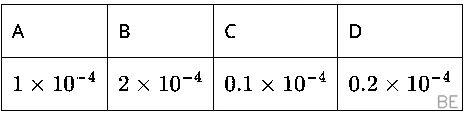
FeO42−+2.2VFe3++0.70VFe2+−0.45VFe0 EFeO42−/Fe2+∘ is x×10−3V. The value of x is _______ [10-Apr-2023 shift 1]
📖 Explanation
Standard electrode potentials are intensive properties that cannot be added directly, whereas Gibbs free energy is an extensive property that allows summation across consecutive reaction steps using the relationship ΔG∘=−nFE∘. The reduction of FeO42− to Fe3+ involves a three-electron transfer with a potential of 2.2 V, and the subsequent reduction of Fe3+ to Fe2+ involves a single-electron transfer with a potential of 0.70 V. Combining these results in an overall four-electron reduction of FeO42− to Fe2+.
Representing the total energy change as the sum of the individual steps gives:
−n3FE3∘=(−n1FE1∘)+(−n2FE2∘)
Substituting the values for the electrons and potentials into the equation:
−4FE3∘=−(3×2.2F)−(1×0.70F)
Dividing both sides by −F simplifies the expression to:
4E3∘=3(2.2)+0.70
The value of the right side equals 7.3, so 4E3∘=7.3. Dividing by 4 gives an electrode potential of E3∘=1.825 V. Comparing this to the format x×10−3 V, the value of x is 1825.