📖 Explanation
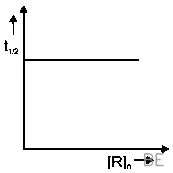
For any first-order reaction, the rate constant k is dictated by the Arrhenius equation, k=Ae−RTEa, which relates the frequency factor and activation energy to the reaction rate at a specific temperature. The time required for 50% of the reactant to convert into the product is defined as the half-life, t1/2, which relates to the rate constant by the expression t1/2=k0.693.
Substituting the provided values into the Arrhenius equation requires converting the activation energy to 191480 J mol−1 to ensure consistency with the units of the gas constant R=8.314 J K−1mol−1. The product RT at 1000 K equals 8314 J mol−1, making the exponent −8314191480=−23.03. Since e−23.03 is numerically equivalent to 10−10, the rate constant simplifies to k=1020×10−10=1010 s−1.
The half-life is then calculated by evaluating t1/2=10100.693, which yields 0.693×10⁻¹⁰ seconds. Converting this duration into picoseconds by multiplying by 1012 results in 69.3 picoseconds. Rounding to the nearest integer gives 69 picoseconds.