Q1GATE 2024MCQ
If the Z-transform of a finite-duration discrete-time signal is , then the -transform of the signal is
GATE EE · Signals And Systems
Generate GATE-level questions on Z-Transform. Focus on: 1. Region of Convergence (ROC) for discrete-time signals. 2. Properties of Z-Transform: Linearity, Shifting, and Convolution. 3. System function H(z), Stability, and Causality analysis.
25 questions · 20 PYQs · 0 AI practice · GATE EE 2027
🎯 These are sample questions
Just sign in to unlock everything. Free for all students.
If the Z-transform of a finite-duration discrete-time signal is , then the -transform of the signal is
The Z-transform of a discrete signal is with ROC = R Which one of the following statements is true?
The casual signal with z-transformer is ( is the unit step signal)
Consider a signal , where 1[n]=0 if , and 1[n]=1 if The z-transform of is with region of convergence being
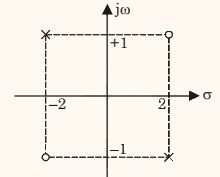
The causal realization of a system transfer function H(s) having poles at (2,-1), (-2,1) and zeroes at (2,1), (-2,-1) will be
Consider a causal and stable LTI system with rational transfer function H(z). Whose corresponding impulse response begins at n = 0. Furthermore, . The poles of H(z) are for k = 1,2,3,4. The zeros of H(z) are all at z = 0. Let . The value of g[8] equals ___________.
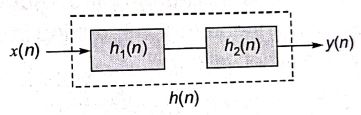
A cascade system having the impulse responses and is shown in the figure below, where symbol denotes the time origin. The input sequence x(n) for which the cascade system produces an output sequence is

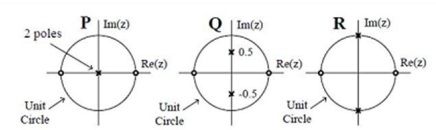
The pole-zero plots of three discrete-time systems P, Q and R on the z-plane are shown below. Which one of the following is TRUE about the frequency selectivity of these systems?
Let . The value of in the range , such that is _______.
Consider a discrete time signal given by The region of convergence of its Z-transform would be
The z-Transform of a sequence x[n] is given as . If y[n] is the first difference of x[n], then Y(z) is given by
Let be the Z -transform of a causal signal x [n]. Then, the values of x[2] and x[3] are
A discrete system is represented by the difference equation
It has initial conditions . The pole locations of the system for a = 1, are
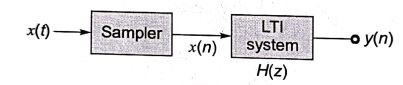
An input signal x(t)=2+5sin(100 t) is sampled with a sampling frequency of 400 Hz and applied to the system whose transfer function is represented by where, N represents the number of samples per cycle. The output y(n) of the system under steady state is
If , then the region of convergence (ROC) of its Z-transform in the Z-plane will be
The z-transform of a signal x[n] is given by . It is applied to a system, with a transfer function . Let the output be y(n). Which of the following is true ?
H(z) is a transfer function of a real system. When a signal is the input to such a system, the output is zero. Further, the Region of convergence (ROC) of H(z) is the entire Z-plane (except z = 0). It can then be inferred that H(z) can have a minimum of
Given with , the residue of at z=a for will be
A signal is processed by a causal filter with transfer function G(s). For a distortion free output signal wave form, G(s) must
A signal is processed by a causal filter with transfer function G(s). is a low pass digital filter with a phase characteristics same as that of the above question if
Want unlimited AI-generated Z Transform questions?
Sign up free and practice with adaptive difficulty — Easy, Medium, Hard. New questions every session.
Start practising for free →