Q1GATE 2026MCQ
Which one of the following statements is equivalent to the following assertion? Turing machine decides the language
GATE CSE · Theory Of Computation
Generate GATE-level questions covering definition of Turing Machines, transitions, configurations, variants (multi-tape, non-deterministic), and language recognition. Include TM design problems.
15 questions · 15 PYQs · 0 AI practice · GATE CSE 2027
🎯 These are sample questions
Just sign in to unlock everything. Free for all students.
Which one of the following statements is equivalent to the following assertion? Turing machine decides the language
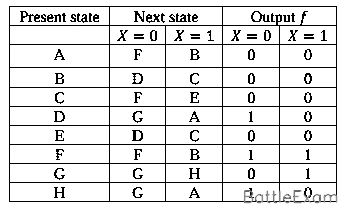
Consider a finite state machine (FSM) with one input and one output , represented by the given state transition table. The minimum number of states required to realize this FSM is _________. (Answer in integer)
Which of the following is/are undecidable?
For a Turing machine M, < M > denotes an encoding of M. Consider the following two languages.
Which one of the following options is correct?
Which of the following languages are undecidable? Note that indicates encoding of the Turing machine . {\left \langle M,w,q \right \rangle|Mon input w reaches state q \in exactly 100 steps}L_3={\left \langle M \right \rangle|L(M) ;is ; not ; recursive}L_4={\left \langle M \right \rangle|L(M) ;contains ; at ; least; 21 ; members}$
Consider the following problems. L(G) denotes the language generated by a grammar G. L(M) denotes the language accepted by a machine M. (I) For an unrestricted grammar G and a string w, whether w L(G) (II) Given a Turing machine M, whether L(M) is regular (III) Given two grammars G1 and G2, whether L(G1) = L(G2) (IV) Given an NFA N, whether there is a deterministic PDA P such that N and P accept the same language. Which one of the following statements is correct?
Let A and B be infinite alphabets and let # be a symbol outside both A and B. Let f be a total functional from A* to B*. We say f is computable if there exists a Turning machine M which given an input x in A*, always halts with f(x) on its tape. Let denote the language {x#f(x)|x A*}. Which of the following statements is true:
Consider the following languages. L1 = { M |M takes at least 2016 steps on some input}, L2 = { M | M takes at least 2016 steps on all inputs} and L3 = { M|M accepts }, where for each Turing machine M, M denotes a specific encoding of M. Which one of the following is TRUE?
Consider the following statements. I. The complement of every Turing decidable language is Turing decidable II. There exists some language which is in NP but is not Turing decidable III. If L is a language in NP, L is Turing decidable Which of the above statements is/are true?
Which of the following is FALSE with respect to possible outcomes of executing a Turing Machine over a given input?
Let be the encoding of a Turing machine as a string over ={0,1}. Let L = { |M is a Turning machine that accepts a string of length 2014}. Then, L is
Which of the following statements is/are FALSE? 1. For every non-deterministic Turing machine, there exists an equivalent deterministic Turing machine. 2. Turing recognizable languages are closed under union and complementation. 3. Turing decidable languages are closed under intersection and complementation. 4. Turing recognizable languages are closed under union and intersection.
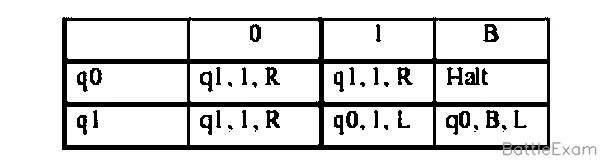
A single tape Turing Machine M has two states q0 and q1, of which q0 is the starting state. The tape alphabet of M is {0, 1, B} and its input alphabet is {0, 1}. The symbol B is the blank symbol used to indicate end of an input string. The transition function of M is described in the following table The table is interpreted as illustrated below. The entry (q1, 1, R) in row q0 and column 1 signifies that if M is in state q0 and reads 1 on the current tape square, then it writes 1 on the same tape square, moves its tape head one position to the right and transitions to state q1. Which of the following statements is true about M ?
Define languages L0 and L1 as follows : L0 = {< M, w, 0 > | M halts on w} L1 = {< M, w, 1 > | M does not halts on w} Here is a triplet, whose first component. M is an encoding of a Turing Machine, second component, w, is a string, and third component, i, is a bit. Let . Which of the following is true ?
Consider the following problem x . Given a Turing machine M over the input alphabet , any state q of M. And a word w ) does the computation of M on w visit the state q ? Which of the following statements about x is correct ?
Want unlimited AI-generated Turing Machines Tm questions?
Sign up free and practice with adaptive difficulty — Easy, Medium, Hard. New questions every session.
Start practising for free →