Q21GATE 2013MCQ
Which of the following is not a necessary condition for deadlock?
GATE CSE · Operating Systems
Generate diverse GATE-level questions covering deadlock conditions, prevention, avoidance (Banker’s algorithm), detection, and recovery techniques.
80 questions · 20 PYQs · 0 AI practice · GATE CSE 2027
Which of the following is not a necessary condition for deadlock?
Consider the following process and resource requirement of each process.
Predict the state of this system, assuming that there are a total of 5 instances of resource type 1 and 4 instances of resource type 2.
A total of 9 units of a resource type available, and given the safe state shown below, which of the following sequence will be a safe state?
A system has n resources , and k processes . The implementation of the resource request logic of each process is as follows: if (i%2= = 0) { if (i[latex]\lt[/latex]n) request [latex]R_{i}[/latex] ; if (i+2[latex]\lt[/latex]n)request [latex]R_{i+2}[/latex]; } else { if (i[latex]\lt[/latex]n) request [latex]R_{n-i}[/latex]; if (i+2[latex]\lt[/latex]n)request [latex]R_{n-i-2}[/latex] ; } In which one of the following situations is a deadlock possible?
When a process is rolled back as a result of deadlock the difficulty which arises is
Consider a system having "n" resources of same type. These resources are shared by 3 processes, A, B, C. These have peak demands of 3, 4, and 6 respectively. For what value of "n" deadlock won't occur
Consider a system with 4 types of resources R1 (3 units), R2 (2 units), R3 (3 units), R4 (2 units). A non-preemptive resource allocation policy is used. At any given instance, a request is not entertained if it cannot be completely satisfied. Three processes P1, P2, P3 request the sources as follows if executed independently. Which one of the following statements is TRUE if all three processes run concurrently starting at time t=0?

In which of the following four necessary conditions for deadlock processes claim exclusive control of the resources they require?
An operating system implements a policy that requires a process to release all resources before making a request for another resource. Select the TRUE statement from the following:
Which of the following is NOT true of deadlock prevention and deadlock avoidance schemes?
Consider a system having 'm' resources of the same type. The resources are shared by 3 processes A, B, C, which have peak time demands of 3, 4, 6 respectively. The minimum value of 'm' that ensures that deadlock will never occur is
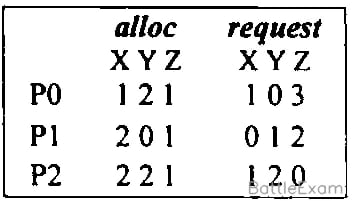
A single processor system has three resource types X, Y and Z, which are shared by three processes. There are 5 units of each resource type. Consider the following scenario, where the column alloc denotes the number of units of each resource type allocated to each process, and the column request denotes the number of units of each resource type requested by a process in order to complete execution. Which of these processes will finish LAST?
Consider the following snapshot of a system running n processes. Process i is holding instances of a resource R, for . Currently, all instances of R are occupied. Further, for all i , process i has placed a request for an additional , instances while holding the instances it already has, There are exactly two processes p and q such that = =0. Which one of the following can serve as a necessary condition to guarantee that the system is not approaching a deadlock?
Two shared resources and are used by processes and . Each process has a certain priority for accessing each resource. Let denote the priority of for accessing . A process can snatch a resource from process if is greater than . Given the following : (I). (II). (III). (IV). Which of the following conditions ensures that and can never deadlock?
Suppose n processes, share m identical resource units, which can be reserved and released one at a time. The maximum resource requirement of process is , where . Which one of the following is a sufficient condition for ensuring that deadlock does not occur?

In a certain operating system, deadlock prevention is attemped using the following scheme. Each process is assigned a unique timestamp, and is restarted with the same timestamp if killed. Let be the process holding a resource R, be a process requesting for the same resource R, and T( ) and T( ) be their timestamps respectively. The decision to wait or preempt one of the processes is based on the following algorithm. if T(Pr) < T(Ph) then kill Pr else wait Which one of the following is TRUE?
The following are the starting and ending times of activities A,B,C,D,E,F,G and H respectively in chronological order: . Here, denotes the starting time and denotes the ending time of activity X. W need to schedule the activities in a set of rooms available to us. An activity can be scheduled in a room only if the room is reserved for the activity for its entire duration. What is the minimum number of rooms required?
Which of the following is not a valid deadlock prevention scheme?
A computer has six tape drives, with n processes competing for them. Each process may need two drives. What is the maximum value of n for the system to be deadlock free?
An operating system contains 3 user processes each requiring 2 units of resource R. The minimum number of units of R such that no deadlocks will ever arise is
Want unlimited AI-generated Deadlocks questions?
Sign up free and practice with adaptive difficulty — Easy, Medium, Hard. New questions every session.
Start practising for free →