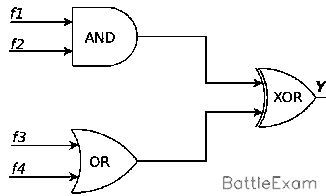
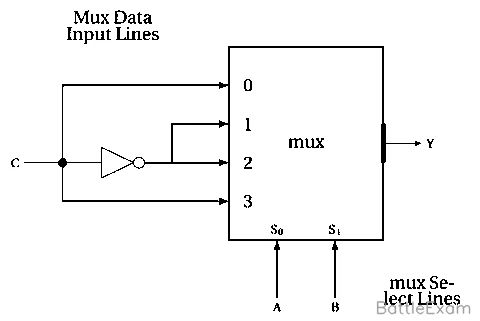
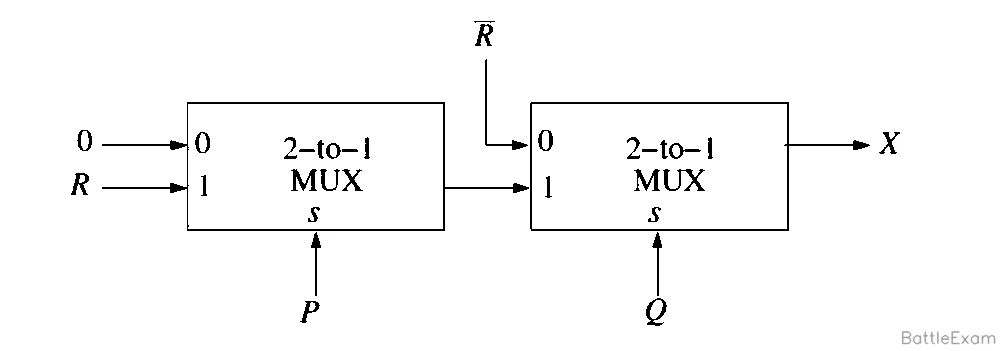
We are given four Boolean functions f1,f2,f3,f4 in sum-of-minterms form and a circuit that computes Y=(f1⋅f2)⊕(f3+f4).
First, let's find the minterms for each function:
f1=∑(0,2,3,5,7,8,11,13)
f2=∑(1,3,5,7,11,13,15)
f3=∑(0,1,4,11)
f4=∑(0,2,6,13)
Next, calculate the intermediate functions in the circuit:
-
AND gate: f1⋅f2. This includes minterms common to both f1 and f2.
f1⋅f2=∑(3,5,7,11,13)
-
OR gate: f3+f4. This includes minterms present in either f3 or f4 (union).
f3+f4=∑(0,1,2,4,6,11,13)
-
XOR gate: Y=(f1⋅f2)⊕(f3+f4). This includes minterms present in exactly one of the two inputs.
Let X1=f1⋅f2=∑(3,5,7,11,13)
Let X2=f3+f4=∑(0,1,2,4,6,11,13)
Common minterms for X1 and X2: ∑(11,13)
Minterms in X1 only: ∑(3,5,7)
Minterms in X2 only: ∑(0,1,2,4,6)
Y=X1⊕X2=∑(minterms \inX1 only)∪∑(minterms \inX2 only)
Y=∑(0,1,2,3,4,5,6,7)
Now, let's check the given options:
(a) Y=∑(0,1,2,11,13) (FALSE)
(b) Y=∑(0,1,2,3,4,5,6,7) (TRUE)
(c) Y=Π(8,9,10,11,12,13,14,15) (This is product of maxterms. It represents the complement of Y in sum-of-terms form. The minterms not in Y are (8,9,10,11,12,13,14,15). So this represents the same function as (b). TRUE)
(d) Y=Π(3,4,5,6,7,8,9,10,12,14,15) (FALSE)
The statements (b) and (c) represent the same function.
Since (b) is directly Y=∑(0,1,2,3,4,5,6,7), and (c) is Y=Π(complement of Y), and the complement of ∑(0,1,2,3,4,5,6,7) is indeed ∑(8,9,10,11,12,13,14,15), this makes both (b) and (c) TRUE.
The PDF solution states (b, c).
===END_Q50===