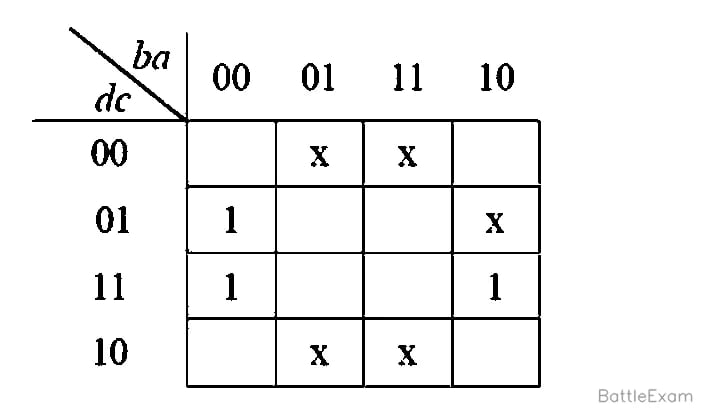
To find the minimum Product-of-Sums (POS) form, we group the 0s in the Karnaugh map.
The function is given by minterms f(w,x,y,z)=∑m(0,1,2,3,7,8,10) and don't cares ∑d(5,6,11,15).
The cells corresponding to 0s are those not in the minterm or don't-care lists: {4, 9, 12, 13, 14}.
We create a K-map for these 0s and group them to find the simplified POS expression.
The K-map for the 0s (with don't cares) is:
   yz
wx 00 01 11 10
00  .  .  .  .
01  0  X  .  X
11  0  0  X  0
10  .  0  X  .
We can form two maximal groups of 0s (including don't cares):
- A group of four covering cells (4, 6, 12, 14). For this group, x=1 and z=0 is not true for all cells. The common variable is z=0 and x changes. This is not a valid group. Let's re-examine. The group for (xˉ+z) corresponds to cells where x=1 and z=0. These are cells 4, 6, 12, 14. Values: 4(0), 6(X), 12(0), 14(0). This is a valid group. The SOP term for fˉ is xzˉ, which gives the POS term (xˉ+z) for f.
- A group of four covering cells (9, 11, 13, 15). Values: 9(0), 11(X), 13(0), 15(X). This is a valid group. The SOP term for fˉ is wz, which gives the POS term (wˉ+zˉ) for f.
Combining these two terms gives the minimal POS form: f=(wˉ+zˉ)(xˉ+z).