GATE CE · Solid Mechanics
Generate GATE-level questions on Theory Of Columns And Shear Centre in Solid Mechanics. Focus on core concepts, previous year patterns, and numerical problem-solving techniques.
15 questions · 15 PYQs · 0 AI practice · GATE CE 2027
🎯 These are sample questions
Just sign in to unlock everything. Free for all students.
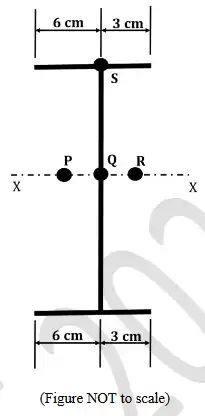
For a thin-walled section shown in the figure, points and are located on the major bending axis of the section. Point is located on the web whereas point is located at the intersection of the web and the top flange of the section. Qualitatively, the shear center of the section lies at
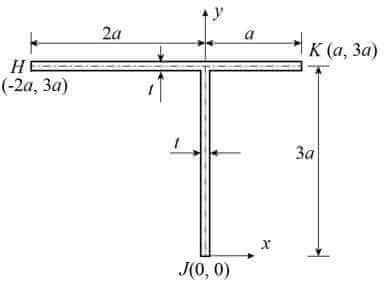
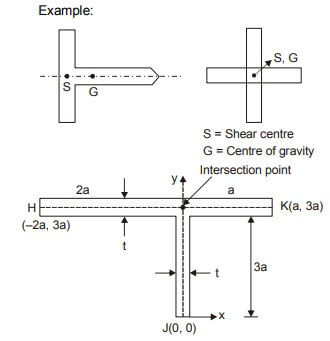
Consider the cross-section of a beam made up of thin uniform elements having thickness shown in the figure. The coordinates of the points along the center-line of the cross-section are given in the figure. The coordinates of the shear center of this cross-section are:

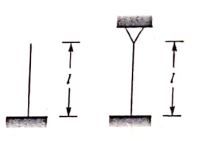
Consider two axially loaded columns, namely, 1 and 2, made of a linear elastic material with Young's modulus MPa, square cross- section with side 10 mm, and length 1 m. For Column 1, one end is fixed and the other end is free. For Column 2, one end is fixed and the other end is pinned. Based on the Euler's theory, the ratio (up to one decimal place) of the buckling load of Column 2 to the buckling load of Column 1 is ________
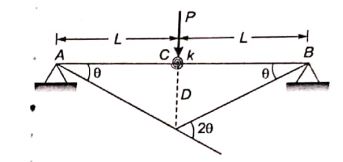
In a system,two connected rigid bars AC and BC are of identical length, L with pin supports at A and B. The bars are interconnected at C by a frictionless hinge. The rotation of the hinge is restrained by a rotational spring of stiffness, k. The system initially assumes a straight line configuration, ACB. Assuming both the bars as weightless, the rotation at supports, A and B, due to a transverse load, P applied at C is
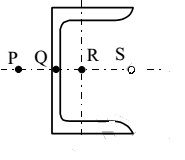
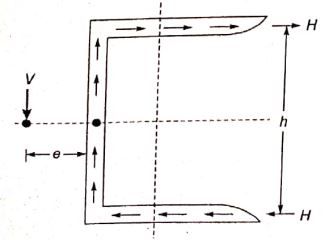
The possible location of shear centre of the channel section, shown below, is

Two steel columns P (length L and yield strength = 250 MPa) and Q (length 2L and yield strength = 500 MPa) have the same cross-sections and end-conditions. The ratio of buckling load of column P to that of column Q is:
The ratio of the theoretical critical buckling load for a column with fixed ends to that of another column with the same dimensions and material, but with pinned ends, is equal to
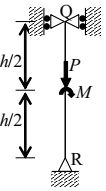
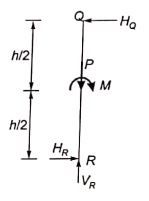
The sketch shows a column with a pin at the base and rollers at the top. It is subjected to an axial force P and a moment M at mid-height. The reaction(s) at R is/are

The effective length of a column of length L fixed against rotation and translation at one end and free at the other end is
The point within the cross sectional plane of a beam through which the resultant of the external loading on the beam has to pass through to ensure pure bending without twisting of the cross-section of the beam is called
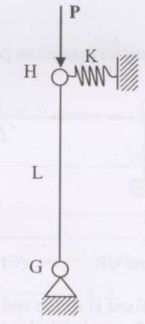
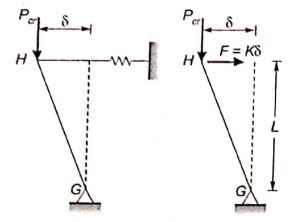
A rigid bar GH of length L is supported by a hinge and a spring of stiffness K as shown in the figure below. The buckling load, , for the bar will be

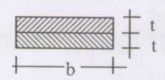
Cross-section of a column consisting to two steel strips, each of thickness t and width b is shown in the figure below. The critical loads of the column with perfect bond and without bond between the strips are and respectively. The ratio is

A steel column, pinned at both end, has a buckling load of 200 kN. If the column is restrained against lateral movement at its mid-height, it buckling load will be
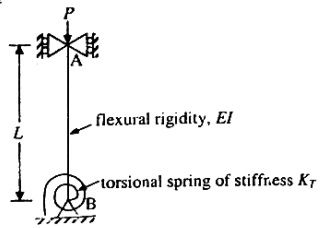
The buckling load for the column AB shown in figure, as approaches infinity, becomes , where is equal to

A long structural column (length= L) with both ends hinged is acted upon by an axial compressive load, P. The differential equation governing the bending of column is given by : Where y is the structural lateral deflection and EI is the flexural rigidity. The first critical load on column responsible for its buckling is given by
Want unlimited AI-generated Theory Of Columns And Shear Centre questions?
Sign up free and practice with adaptive difficulty — Easy, Medium, Hard. New questions every session.
Start practising for free →