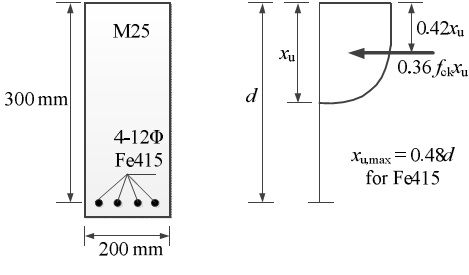
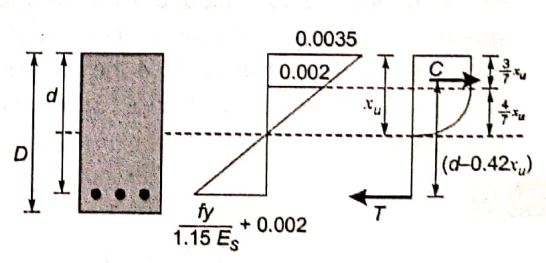
Q21GATE 2015NATConsider the singly reinforced beam section given below (left figure). The stress block parameters for the cross-section from IS: 456 : 2000 are also given below (right figure). The moment of resistance for the given section by the limit state method is ________ kN-mShow Answer🚀 Solve in Practice Mode📖 ExplanationAst=4×π4×122=452.38mm2xu,lim=0.48×300=144mm∵C=T⇒0.36fckbxu=0.87fyAst⇒xu=0.87fyAst0.36fckb=90.73mm\begin{aligned} A_{s t} &=4 \times \frac{\pi}{4} \times 12^{2} \\ &=452.38 \mathrm{mm}^{2} \\ x_{u, \lim } &=0.48 \times 300=144 \mathrm{mm} \\ \because \quad C &=T \\ \Rightarrow \quad 0.36 f_{c k} b x_{u} &=0.87 \mathrm{f}_{y} A_{s t} \\ \Rightarrow \quad x_{u}&=\frac{0.87 f_{y} A_{s t}}{0.36 f_{c k} b}=90.73 \mathrm{mm} \end{aligned}Astxu,lim∵C⇒0.36fckbxu⇒xu=4×4π×122=452.38mm2=0.48×300=144mm=T=0.87fyAst=0.36fckb0.87fyAst=90.73mm ∵xu<xu,lim,\because x_{u} \lt x_{u, l \mathrm{im}},∵xu<xu,lim, it is under reinforced section ⇒MOR=0.36fckbxu(d−0.42xu)=42.7708×10⁶N−mm=42.7708kN−m\begin{aligned} \Rightarrow \quad M O R&=0.36 f_{c k} b x_{u}\left(d-0.42 x_{u}\right) \\ &=42.7708 \times 10^{6} \mathrm{N}-\mathrm{mm} \\ &=42.7708 \mathrm{kN}-\mathrm{m} \end{aligned}⇒MOR=0.36fckbxu(d−0.42xu)=42.7708×10⁶N−mm=42.7708kN−m
Q23GATE 2015NATAccording to the concept of Limit State Design as per IS 456: 2000, the probability of failure of a structure is__________.Show Answer🚀 Solve in Practice Mode📖 ExplanationThe structure may fail when, the load exceeds the design load (ii) the strength is less than the characteristic strength (iii) both the load exceeds the design load and strength is less than the characteristic strength. The probability of load exceeding design load = 5% (iv) The probability of strength less than characteristic strength = 5% The probability of failure is =0.05×0.95+0.05×0.95+0.05×0.05=0.05 \times 0.95+0.05 \times 0.95+0.05 \times 0.05=0.05×0.95+0.05×0.95+0.05×0.05 =0.0975=0.0975=0.0975
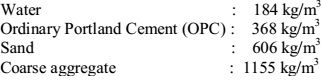
Q24GATE 2015NATThe composition of an air-entrained concrete is given below: Assume the specific gravity of OPC, sand and coarse aggregate top be 3.14, 2.67 and 2.74, respectively. The air content is ________ litres/m3litres/m^{3}litres/m3 .Show Answer🚀 Solve in Practice Mode📖 ExplanationLet the total volume of air-entrained concrete is unity. MCρC+MFAρFA+MCAρCA+VW+VAir=1.03683.14×1000+6062.67×1000+11552.74×1000+1841000+VV=1.00.11720+0.22697+0.42153+0.184+Vv=1.0VV=0.0503VV=0.0503×1000=50.3 litres/m3\begin{array}{c} \frac{M_{C}}{\rho_{C}}+\frac{M_{F A}}{\rho_{F A}}+\frac{M_{C A}}{\rho_{C A}}+V_{W}+V_{\mathrm{Air}}=1.0 \\ \frac{368}{3.14 \times 1000}+\frac{606}{2.67 \times 1000} \\ +\frac{1155}{2.74 \times 1000}+\frac{184}{1000}+V_{V}=1.0 \\ 0.11720+0.22697+0.42153 \\ \begin{aligned} +0.184+V_{v}&=1.0 \\ V_{V}&=0.0503 \\ V_{V}&=0.0503 \times 1000 \\ \quad&=50.3\; litres / \mathrm{m}^{3} \end{aligned} \end{array}ρCMC+ρFAMFA+ρCAMCA+VW+VAir=1.03.14×1000368+2.67×1000606+2.74×10001155+1000184+VV=1.00.11720+0.22697+0.42153+0.184+VvVVVV=1.0=0.0503=0.0503×1000=50.3litres/m3
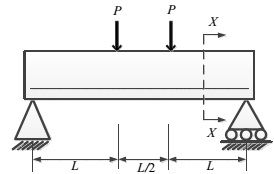
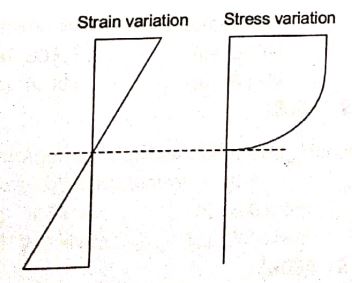
Q25GATE 2015MCQConsider the singly reinforced beam shown in the figure below: At cross-section XX, which of the following statements is TRUE at the limit state?A. The variation of stress is linear and that of strain is non-linearB. The variation of strain is linear and that of stress is non-linearC. The variation of both stress and strain is linearD. The variation of both stress and strain is non- linearShow Answer🚀 Solve in Practice Mode📖 ExplanationCurrently no explanation available
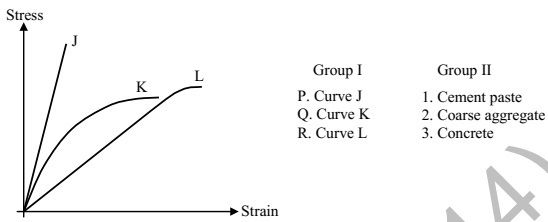
Q26GATE 2014MCQGroup I contains representative stress-strain curves as shown in the figure, while Group II given the list of materials. Match the stress-strain curves with the corresponding materials.A. P-1; Q-3; R-2B. P-2; Q-3; R-1C. P-3; Q-1; R-2D. P-3; Q-2; R-1Show Answer🚀 Solve in Practice Mode📖 ExplanationCurrently no explanation available
Q27GATE 2014MCQThe target means strength fcmf_{cm}fcm for concrete mix design obtained from the characteristic strength fckf_{ck}fck and standard deviation σ\sigmaσ , as defined in IS:456-2000, isA. fck+1.35σf_{ck}+1.35\sigmafck+1.35σB. fck+1.45σf_{ck}+1.45\sigmafck+1.45σC. fck+1.55σf_{ck}+1.55\sigmafck+1.55σD. fck+1.65σf_{ck}+1.65\sigmafck+1.65σShow Answer🚀 Solve in Practice Mode📖 ExplanationCurrently no explanation available
Q28GATE 2014NATThe flexural tensile strength of M25 grade of concrete, in N/mm2N/mm^{2}N/mm2 , as per IS:456-2000 isShow Answer🚀 Solve in Practice Mode📖 Explanation Flexural strength =0.7fck=3.5N/mm2\text { Flexural strength }=0.7 \sqrt{f_{c k}}=3.5 \mathrm{N} / \mathrm{mm}^{2} Flexural strength =0.7fck=3.5N/mm2
Q29GATE 2014MCQThe modulus of elasticity, E=5000fckE=5000\sqrt{f_{ck}}E=5000fck where fckf_{ck}fck is the characteristic compressive strength of concrete, specified in IS:456-2000 is based onA. tangent modulusB. initial tangent modulusC. secant modulusD. chord modulusShow Answer🚀 Solve in Practice Mode📖 ExplanationIn IS:456-2000, the modulus of elasticity of concrete is given by: E=5000fck(\inMPa)E = 5000 \sqrt{f_{ck}} \quad \text{(\in MPa)}E=5000fck(\inMPa) This value is derived from the stress-strain curve of concrete and is defined as the secant modulus, which is the slope of the line joining the origin to a point on the stress-strain curve at working stress level (typically at 0.33 of ultimate strength).
Q30GATE 2014MCQThe first moment of area about the axis of bending for a beam cross-section isA. moment of inertiaB. section modulusC. shape factorD. polar moment of inertiaShow Answer🚀 Solve in Practice Mode📖 ExplanationCurrently no explanation available
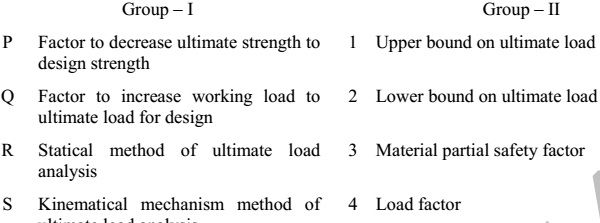
Q31GATE 2014MCQMatch the information given in Group - I with those in Group - II.A. P-1; Q-2; R-3; S-4B. P-2; Q- ; R-4; S-3C. P-3; Q-4; R-2; S-1D. P-4; Q-3; R-2; S -1Show Answer🚀 Solve in Practice Mode📖 ExplanationCurrently no explanation available
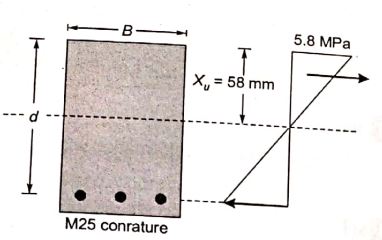
Q32GATE 2014MCQIn a reinforced concrete section, the stress at the extreme fibre in compression is 5.80 MPa. The depth of neutral axis in the section is 58 mm and the grade of concrete is M25. Assuming linear elastic behavior of the concrete, the effective curvature of the section (in per mm) isA. 2.0×10−62.0\times 10^{-6}2.0×10⁻⁶B. 3.0×10−63.0\times 10^{-6}3.0×10⁻⁶C. 4.0×10−64.0\times 10^{-6}4.0×10⁻⁶D. 5.0×10−65.0\times 10^{-6}5.0×10⁻⁶Show Answer🚀 Solve in Practice Mode📖 ExplanationModulus of elasticity of concrete. E=500025=25000N/mm2∴MI=σy=ER⇒1R=σEy=5.8EXu Curvature =5.858×25000=4×10⁻⁶Per mm⇒ Curvature =4×10⁻⁶per mm\begin{aligned} E &=5000 \sqrt{25} \\ &=25000 \mathrm{N} / \mathrm{mm}^{2} \\ \therefore \quad \frac{M}{I} &=\frac{\sigma}{y}=\frac{E}{R} \\ \Rightarrow \quad \frac{1}{R} &=\frac{\sigma}{E y}=\frac{5.8}{E X_{u}} \\ \text { Curvature } &=\frac{5.8}{58 \times 25000} \\ &=4 \times 10^{-6} \text {Per } \mathrm{mm} \\ \Rightarrow \quad \text { Curvature }&=4 \times 10^{-6} \text {per } \mathrm{mm} \end{aligned}E∴IM⇒R1 Curvature ⇒ Curvature =500025=25000N/mm2=yσ=RE=Eyσ=EXu5.8=58×250005.8=4×10−6Per mm=4×10⁻⁶per mm
Q33GATE 2014NATWhile designing, for a steel column of Fe250 grade, a base plate resting on a concrete pedestal of M20 grade, the bearing strength of concrete (in N/mm2N/mm^{2}N/mm2 ) in limit state method of design as per IS:456-2000 is ________________Show Answer🚀 Solve in Practice Mode📖 Explanation Permissible bearing stress =0.45fck=0.45×20=9N/mm2\begin{aligned} &\text { Permissible bearing stress } \\ &=0.45 \mathrm{f}_{\mathrm{ck}} \\ &=0.45 \times 20=9 \mathrm{N} / \mathrm{mm}^{2} \\ \end{aligned} Permissible bearing stress =0.45fck=0.45×20=9N/mm2
Q34GATE 2013MCQMaximum possible value of Compacting Factor for fresh (green) concrete is:A. 0.5B. 1C. 1.5D. 2Show Answer🚀 Solve in Practice Mode📖 ExplanationCurrently no explanation available
Q35GATE 2012MCQAs per IS 456:2000, in the Limit State Design of a flexural member, the strain in reinforcing bars under tension at ultimate state should not be less thanA. fyEs\frac{f_{y}}{E_{s}}EsfyB. fyEs+0.002\frac{f_{y}}{E_{s}}+0.002Esfy+0.002C. fy1.15Es\frac{f_{y}}{1.15E_{s}}1.15EsfyD. fy1.15Es+0.002\frac{f_{y}}{1.15E_{s}}+0.0021.15Esfy+0.002Show Answer🚀 Solve in Practice Mode📖 ExplanationCurrently no explanation available
Q36GATE 2011MCQThe cross-section of a thermo-mechanically treated (TMT) reinforcing bar hasA. soft ferrite-pearlite throughoutB. hard martensite throughoutC. a soft ferrite-pearlite core with a hard martensitic rimD. a hard martensitic core with a soft pearlite-bainitic rimShow Answer🚀 Solve in Practice Mode📖 ExplanationCurrently no explanation available
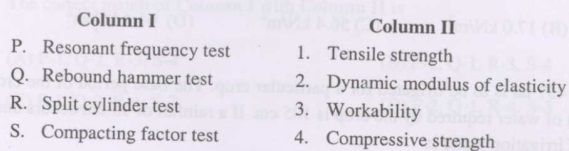
Q37GATE 2009MCQColumn-I gives a list of test methods for evaluating properties of concrete and Column-II gives the list of properties. The correct match of the test with the property isA. P-2 Q-4 R-1 S-3B. P-2 Q-1 R-4 S-3C. P-2 Q-4 R-3 S-1D. P-4 Q-3 R-1 S-2Show Answer🚀 Solve in Practice Mode📖 ExplanationP. Resonant frequency test is used to determine dynamic modulus of elasticity whereas destructive test like cube test etc measures the static modulus of elasticity. Q. Rebound hammer test is a non-destructive test used for compressive strength of concrete. R. Split cylinder test is used to determine the direct tensile strength of concrete. S. Compaction factor test is used to measure workability of concrete.
Q38GATE 2009MCQFor limit state of collapse, the partial safety factors recommended by IS 456:2000 for estimating the design strength of concrete and reinforcing steel are respectivelyA. 1.15 and 1.5B. 1.0 and 1.0C. 1.5 and 1.15D. 1.5 and 1.0Show Answer🚀 Solve in Practice Mode📖 ExplanationCurrently no explanation available
Q39GATE 2009MCQThe modulus of rupture of concrete in terms of its characteristic cube compressive strength ( fckf_{ck}fck ) in MPa according to IS 456:2000 isA. 5000fck5000f_{ck}5000fckB. 0.7fck0.7f_{ck}0.7fckC. 5000fck5000\sqrt{f_{ck}}5000fckD. 0.7fck0.7\sqrt{f_{ck}}0.7fckShow Answer🚀 Solve in Practice Mode📖 ExplanationCurrently no explanation available
Q40GATE 2008MCQUn-factored maximum bending moment at a section of a reinforced concrete beam resulting form a frame analysis are 50, 80, 120 and 180 kNm under dead, live, wind and earthquake loads respectively. The design moment (kNm) as per IS:456-2000 for the limit state of collapse (flexure) isA. 195B. 250C. 345D. 372Show Answer🚀 Solve in Practice Mode📖 ExplanationWind and earthquake effects are not considered simultaneously. (i) Design moment when wind effect is considered =1.2(DL+LL+WL)=1.2(50+80+120)=300kN−m\begin{aligned} &=1.2(\mathrm{DL}+\mathrm{LL}+\mathrm{WL}) \\ &=1.2(50+80+120) \\ &=300 \mathrm{kN}-\mathrm{m} \end{aligned}=1.2(DL+LL+WL)=1.2(50+80+120)=300kN−m (ii) Design moment when earthquake effect is considered =1.2(DL+LL+EL)=1.2(50+80+180)=372kN−m\begin{aligned} &=1.2(\mathrm{DL}+\mathrm{LL}+\mathrm{EL}) \\ &=1.2(50+80+180) \\ &=372 \mathrm{kN}-\mathrm{m} \end{aligned}=1.2(DL+LL+EL)=1.2(50+80+180)=372kN−m