GATE CE · Irrigation Engineering
Generate GATE-level questions on Design Of Stable Channels in Irrigation Engineering. Focus on core concepts, previous year patterns, and numerical problem-solving techniques.
12 questions · 12 PYQs · 0 AI practice · GATE CE 2027
🎯 These are sample questions
Just sign in to unlock everything. Free for all students.
Lacey's regime equations, followed in India for making scour calculations while designing hydraulic structures across alluvial channels, are given below. Regarding these equations, which of the following statements is/are true: where, is discharge and is silt factor
A symmetrical trapezoidal canal is 100 km long. The bottom width is 10 m and the side slope is 1 Horizontal : 1 Vertical. The average flow depth in the canal is 2.5 m throughout the month of April. The measurement from a Class-A evaporimeter in the vicinity of the canal indicated an average evaporation rate of 0.5 cm viay in April. The volume of water evaporated from the canal (in ) in the month of April is close to _________ (rounded off to 1 decimal place).
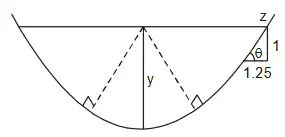
A round-bottom trianglular lined canal is to be liad at a slope of in 1500 , to carry a discharge of . The side slopes of the canal cross-section are to be kept at . If Manning's roughtness coefficient is 0.013 , the flow depth (in meters) will be in the range of
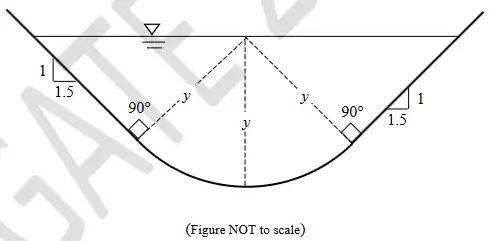
A standard round bottom triangular canal section as shown in the figure has a bed slope of 1 in 200. Consider the Chezy's coefficient as 150 1/2/s. The normal depth of flow, is ____ (rounded off to 2 decimal places).

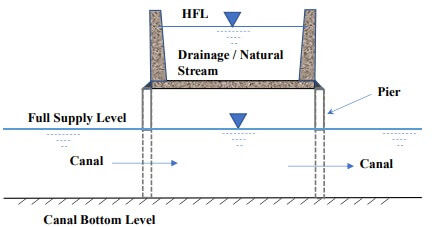
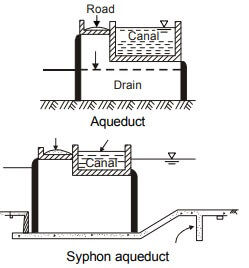
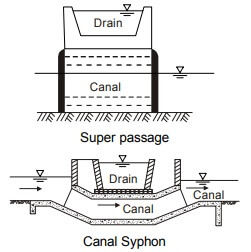
Identify the cross-drainage work in the figure.

In the context of cross-drainage structures, the correct statement(s) regarding the relative positions of a natural drain (stream/river) and an irrigation canal, is/are
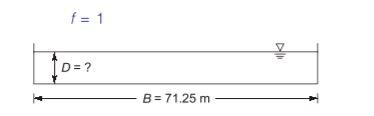
An unlined canal under regime conditions along with a silt factor of 1 has a width of flow 71.25m. Assuming the unlined canal as a wide channel, the corresponding average depth of flow (in m, round off to two decimal places) in the canal will be ______________
The depth of flow in an alluvial channel is 1.5 m. If critical velocity ratio is 1.1 and Manning's n is 0.018, the critical velocity of the channel as per Kenedy's method is
A stable channel is to be designed for a discharge of Q with silt factor f as per Lacey's method. The mean flow velocity (m/s) in the channel is obtained by
As per the Lacey's method for design of alluvial channels, identify the TRUE statement from the following :
A launching apron is to be designed at downstream of a weir for discharge intensity of 6.5 /s/m. For the design of launching aprons the scour depth is taken two times of Lacey scour depth. The silt factor of the bed material is unity. If the tailwater depth is 4.4 m, the length of launching apron in the launched position is
On which of the canal systems, R.G. Kennedy, executive engineer in the the Punjab Irrigation Department made his observations for proposing his theory on stable channels ?
Want unlimited AI-generated Design Of Stable Channels questions?
Sign up free and practice with adaptive difficulty — Easy, Medium, Hard. New questions every session.
Start practising for free →